
We have learned to conquer diseases, extend life, explore the universe and create intelligent machines. Can we now learn to transcend hatred, abolish war and build a civilisation worthy of our technological achievements?
1. We Have Become Powerful. Have We Become Good?
We live in an extraordinary period of human history. Never before have so many people had access to education, scientific knowledge, medical treatment and technological possibilities. We have learned to transplant human organs, alter genetic structures, communicate across continents almost instantaneously, and construct machines capable of performing tasks once considered the exclusive domain of human intelligence. What earlier generations regarded as miraculous has become part of everyday life.
Yet something remains deeply unsettling about our achievements.
The same civilisation that produces life-saving medicines manufactures weapons capable of annihilating millions. The same intelligence that allows us to explore distant galaxies continues to struggle with elementary questions of coexistence here on Earth. We have developed extraordinary capacities to understand nature, but our ability to understand, respect and live peacefully with one another has not advanced at a comparable pace.
In 2025, global military expenditure reached approximately US$2.887 trillion, according to the Stockholm International Peace Research Institute. That was the eleventh consecutive year of increasing military spending. At the same time, many countries continue to face serious shortcomings in basic healthcare, education and social protection.
The contradiction is not merely economic. It is fundamentally moral.
We have become exceedingly capable. Have we become correspondingly responsible?
We possess tremendous knowledge. Have we cultivated sufficient wisdom?
We can now create increasingly autonomous machines. But can we create more humane societies?
These questions concern the very destiny of our civilisation. In my books Hope in/for Humanity: Becoming the Best Generation by Addressing Global Challenges Through Ethical Consciousness and Ethics, Artificial Intelligence and Human Destiny: Our Collective Search, I have argued that hope must be joined to responsibility. The future is neither automatically promising nor inevitably catastrophic. It depends significantly on the ethical choices we make together.
I want to carry that argument further.
Humanity’s next great achievement must be the advancement of our collective moral consciousness.
This may sound idealistic. But history offers substantial evidence that moral consciousness can grow. Indeed, some of humanity’s most significant achievements have been moral rather than technological.
Practices once defended as natural, necessary or divinely sanctioned have become morally unacceptable. Institutions once considered permanent have been dismantled. People once denied fundamental rights have won recognition as equal members of the human community.

If we have transformed our moral understanding before, why should we believe we cannot do so again?
And if slavery, colonial domination and legally enforced racial segregation could be challenged and overcome, at least in their institutional forms, why should we regard war, extreme poverty, systemic exploitation or technological domination as permanent features of human civilisation?
Our greatest challenge may no longer be discovering what we can do.
It may be deciding what we must never again do to one another.
2. Moral Progress Is Possible: History Has Already Demonstrated It
One of the most encouraging discoveries about human history is that moral practices change. Not all change is progress, certainly. Societies can regress, become crueler and betray their own ideals. Nevertheless, there are instances in which humanity has unmistakably expanded the recognition of human dignity and reduced the legitimacy of previously accepted forms of domination.
Consider slavery.
For centuries, human beings were bought, sold, inherited and treated as property. Slavery was supported by political institutions, economic interests, philosophical arguments and even religious interpretations. Aristotle, in the Politics (Book I), defended the possibility of natural slavery, an argument that now rightly strikes us as incompatible with equal human dignity.
Over time, abolitionists challenged this accepted order. Enslaved people resisted, organised, escaped and fought for freedom. Religious reformers, philosophers, political movements and ordinary citizens contributed to the eventual abolition of legal slavery across much of the world.
The transformation was neither smooth nor inevitable. It required centuries of struggle, sacrifice and institutional change. Its incompleteness is evident in contemporary human trafficking, forced labour and debt bondage.
Nevertheless, an important moral boundary had shifted. The ownership of one human being by another, once legally normal, became internationally condemned.
That is moral progress.
The same broad pattern appears in movements against racial segregation, colonial subjugation, the denial of women’s suffrage, and practices of discrimination based on caste or inherited social status.
The achievement is not that injustice has disappeared. It is that humanity has acquired stronger moral, legal and political grounds for naming and resisting it.
When accepted practices become moral wrongs
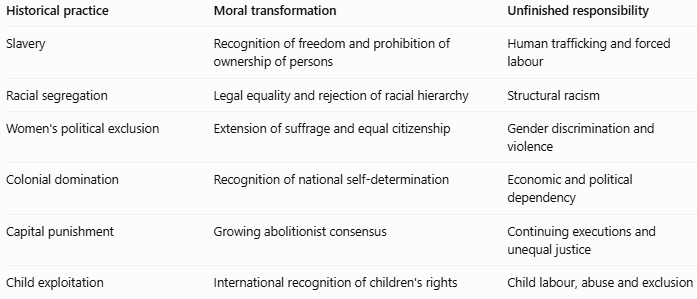
These are historical changes in law, public norms and institutions—not claims that the underlying injustices have disappeared.
The death penalty: a remarkable change in moral thinking
Few examples illustrate moral transformation as clearly as the movement against capital punishment.
For much of recorded history, execution was regarded as a legitimate expression of sovereign authority and criminal justice. Public executions were sometimes treated as entertainment, spectacle or moral instruction. States claimed the right to punish wrongdoing by taking the life of the offender.
Today, a growing number of societies have concluded that even those who commit terrible crimes retain an inviolable claim to human dignity.
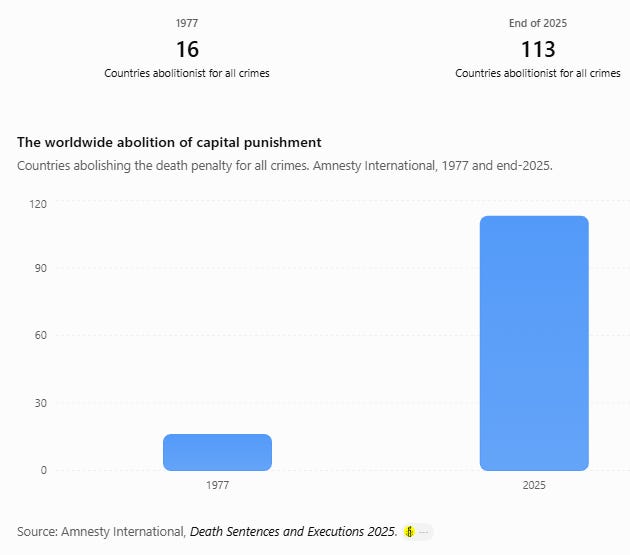
This expansion reflects a significant change in the moral understanding of punishment. Justice is increasingly understood by abolitionist societies as something that must protect the community without necessarily destroying the offender.
But history also warns against complacency. Amnesty International documented at least 2,707 executions in 2025, compared with 1,518 in 2024, excluding figures believed to be substantial in countries where execution data remain secret. Although the number of executing countries was only 17, recorded executions rose dramatically.

Amnesty International
This apparent contradiction teaches us something important.
Moral progress is possible, but it is never secure.
We can establish a higher ethical standard and still violate it. We can recognise a universal principle while failing to apply it consistently. Moral consciousness grows through struggle, and its achievements require constant vigilance.
The lesson is not that humanity has become good. It is that humanity is capable of recognising and rejecting forms of cruelty that earlier generations accepted.
That capacity is enormously significant.
3. What Exactly Is Moral Consciousness?
We must now ask a philosophical question. What do we mean by moral consciousness, and how is it different from ordinary moral behaviour?
Morality refers broadly to judgments, values and practices concerning right and wrong. Ethics subjects these judgments to critical examination. Conscience concerns our capacity to recognise moral obligations and judge our own actions.
Moral consciousness, as I understand it, includes these dimensions but goes further. It involves becoming aware of the moral significance of our actions, relationships, institutions and collective ways of living.
It requires us to recognise not only that an individual may act unjustly, but that a social arrangement itself may be unjust.
A slave owner might occasionally treat enslaved people kindly while continuing to accept slavery as legitimate. Genuine moral development required recognition that the institution of slavery itself was wrong.
Similarly, an employer may treat individual workers politely while participating in economic arrangements that systematically undermine their dignity. A government may express concern for civilian suffering while sustaining policies that make such suffering predictable.
Moral consciousness must therefore move from isolated acts of kindness towards an examination of the structures that shape human life.
This is especially important in our interconnected world.
A consumer’s purchase may depend on invisible labour in another country. A corporation’s technological innovation may influence elections or employment across continents. A nation’s environmental policies may affect populations that have little political influence over its decisions.
Responsibility has become increasingly collective because the consequences of our actions have become increasingly interconnected.
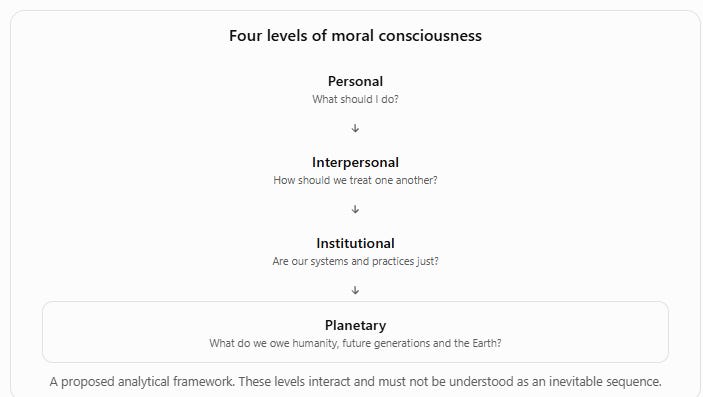
Kant’s moral philosophy offers one foundation for this argument. His insistence that human beings must be treated as ends rather than merely as means places dignity at the centre of moral judgment (Groundwork of the Metaphysics of Morals, 1785).
Hegel directs attention towards institutions and historical forms of ethical life. Morality cannot be reduced to personal intentions; it must acquire expression in social relationships and political structures (Elements of the Philosophy of Right, 1821).
Carol Gilligan (1982) reminds us that moral reasoning also involves care, relationship and responsiveness to particular vulnerabilities. Peter Singer (1981), in The Expanding Circle, examines how moral consideration can move beyond narrow affiliations.
Indian philosophical traditions bring further resources. Buddhist karuṇā emphasises compassion for suffering beings. Jain ahiṃsā demands serious reflection on the harm we inflict on living creatures. Gandhi transformed nonviolence from an individual virtue into an instrument of collective political action. Ambedkar insisted that constitutional democracy could not flourish without the corresponding social morality of liberty, equality and fraternity.
These traditions differ in their metaphysical foundations and moral reasoning. Their differences should not be erased. Nevertheless, they help us see that ethical maturity requires more than personal success or intellectual achievement. It involves learning to live responsibly with others.
4. Our Civilisational Imbalance: Extraordinary Power, Insufficient Wisdom
The technological achievements of the last century have been astonishing. Developments that once unfolded across generations now emerge within years, sometimes months.
We are learning to edit genes, produce vaccines through new technological platforms, automate complex decisions and develop increasingly powerful artificial intelligence. These advances may alleviate suffering, expand human capabilities and open possibilities that earlier generations could barely imagine.
But technology increases our capacity to act. It does not, by itself, determine whether our actions are morally justified.
A scientific discovery may be used to cure disease or to develop biological weapons. Artificial intelligence may facilitate education and medical diagnosis, but it may also enable manipulation, surveillance and autonomous violence.
The same technological infrastructure that creates global connectivity can spread hatred and disinformation at an unprecedented scale.
This is the central problem explored in my recent books, including Ethics of AI: Humanity’s Best or Last Invention and AI Can Help, Not Save Us: Human Dignity, and the Moral Revolution We Still Need. My central concern is that intelligence without conscience cannot guarantee human flourishing. Increasingly powerful technologies must remain accountable to human dignity, justice and the common good.

Ethics must govern power, not merely follow it.
My edited volume Applied Ethics and Rationality: Contemporary Indian Perspectives brings contemporary Indian philosophical traditions into conversation with problems of ethical reasoning and institutional responsibility.
Such work becomes especially urgent when innovation changes the conditions of human life faster than our institutions can respond.
Consider autonomous weapons. If a machine identifies and attacks a human target, where does moral responsibility lie? With the programmer? The military commander? The political leader? The institution that authorised its deployment?
Or consider algorithmic discrimination. An automated decision-making system may reproduce social inequalities without any individual consciously intending to discriminate.
These examples reveal a transformation in the moral landscape. Our technologies are increasingly collective in their production, distributed in their operation and far-reaching in their consequences.
Ethics must respond at the same scale.
The familiar distinction between what we can do and what we ought to do has acquired civilisational urgency. Without such reflection, technological sophistication may coexist with astonishing moral primitiveness.
We might then become a civilisation capable of creating intelligence without knowing how to use it wisely.
5. If We Could Abolish Slavery, Why Can We Not Abolish War?
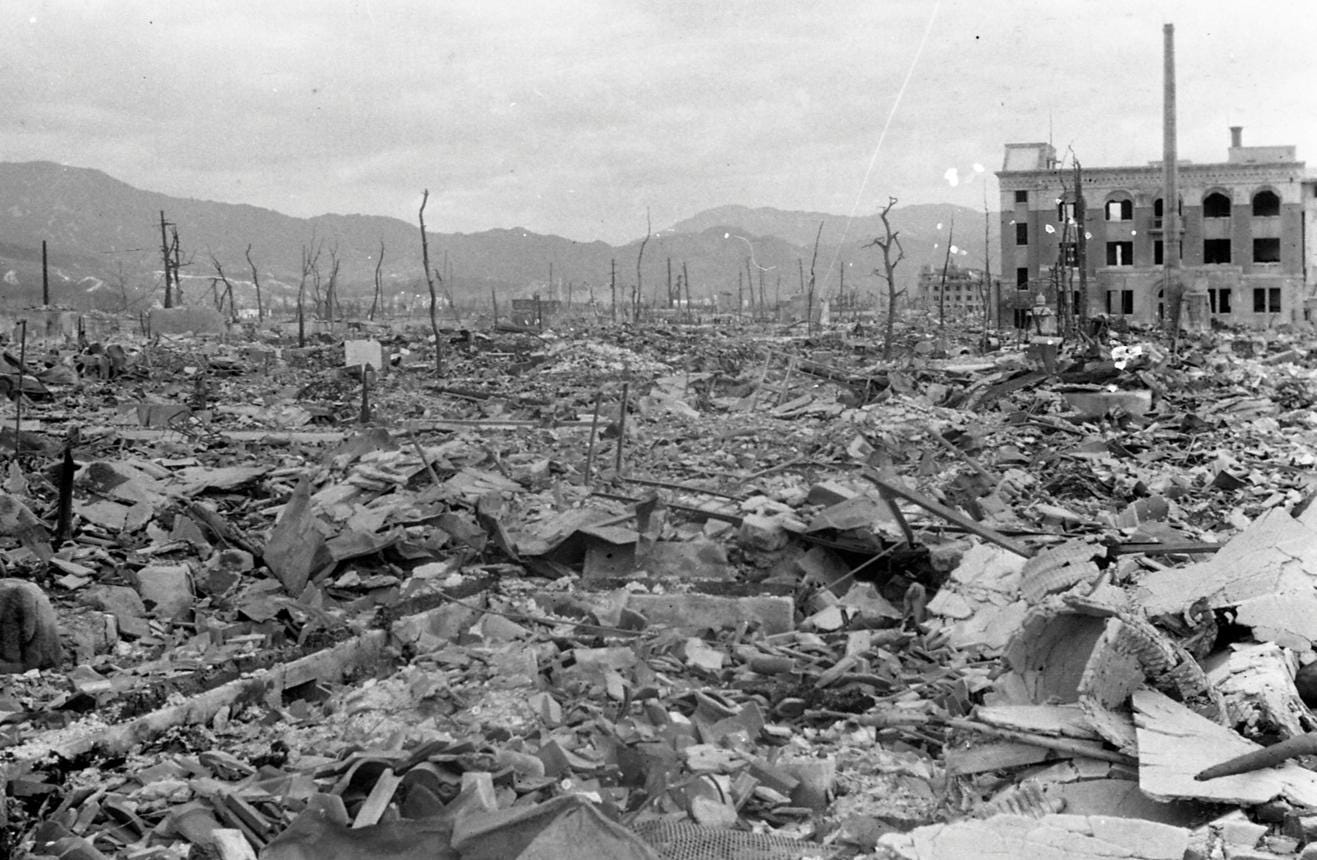
The devastation of Hiroshima reminds us that technological ingenuity can become an instrument of catastrophic destruction.
Let us now consider a question that may initially appear utopian.
Why must war continue?
For much of human history, warfare has been regarded as an unavoidable instrument of politics. States have fought over territory, resources, power, security, religion and ideological differences. Many societies have glorified military conquest, celebrated victorious warriors and considered national greatness inseparable from military strength.
Yet we should distinguish between a practice being widespread and its being morally necessary.
Slavery was widespread. So was colonial conquest. So were public executions. Their historical prevalence did not establish their moral legitimacy.
Could future generations come to regard organised warfare in a similar way?
I believe this possibility deserves serious consideration.
Imagine a civilisation in which sending thousands of young people to kill and die in order to settle political disagreements is regarded as a failure of human reason and collective responsibility. Imagine international institutions sufficiently credible and effective that states increasingly settle disputes through law, negotiation, mediation and enforceable agreements.
Such a world would not necessarily be free from conflict. Conflict is an enduring feature of human relationships. But conflict need not inevitably become organised killing.
There is a difference between abolishing disagreement and rejecting warfare as a legitimate method of resolving disagreement.
Kant, Gandhi and the possibility of peace
In Toward Perpetual Peace (1795), Kant argued that peace must be established through political and juridical arrangements. It cannot depend merely on the temporary goodwill of rulers. Republican institutions, international law and a federation of free states would create conditions in which war could become less likely.
Gandhi’s contribution was different but complementary. His philosophy of satyagraha demonstrated that resistance to injustice need not always reproduce the violence it opposes. Nonviolence was not passive submission. It could become disciplined, collective and politically transformative.
One should not romanticise this achievement. Nonviolent resistance has faced repression, and its effectiveness depends partly on historical circumstances. Nevertheless, Gandhi expanded humanity’s political imagination by demonstrating that organised moral resistance could become an alternative to organised physical coercion.
The twentieth century also witnessed attempts to institutionalise restraint through the United Nations, international humanitarian law, arms-control agreements and international courts.
The Treaty on the Prohibition of Nuclear Weapons, adopted in 2017 and entering into force in 2021, represents another significant attempt. By October 2026, it had 75 states parties. The treaty prohibits participating states from possessing, developing, using or threatening to use nuclear weapons. Yet nuclear-armed states remain outside the treaty, revealing the considerable distance between moral aspiration and geopolitical transformation.
This matters enormously. Moral change frequently begins before political consensus is achieved.
The abolitionist movement began when slavery remained legal. Campaigns for women’s suffrage began when women were systematically excluded from political power. Movements for racial equality emerged under institutions that appeared firmly established.
Why, then, should movements for a world beyond war be dismissed merely because their goals have not yet been achieved?
The realist objection
Of course, one must take the opposing argument seriously.
Political realists remind us that states inhabit a world without a universally enforceable central authority. A peaceful nation may face an aggressive neighbour. Disarmament without reciprocal guarantees may expose vulnerable populations to invasion or coercion. The moral rejection of violence does not necessarily eliminate the legitimate need for defence.
These are not trivial objections. Indeed, any credible programme for reducing war must address them.
The ethical challenge is therefore not simply to declare that war is wrong. It is to construct institutions, incentives and relationships that reduce the conditions under which war appears necessary.
Collective security, reliable international law, democratic accountability, confidence-building measures, arms verification, preventive diplomacy, equitable economic relationships and reconciliation processes are indispensable.
Peace requires institutional imagination no less than moral conviction.
We need to move from a world in which war is merely regulated towards one in which the incentives, legitimacy and opportunities for war are systematically diminished.
The abolition of war may be humanity’s greatest unfinished moral project.
I do not claim that it is inevitable. I claim that its possibility should become an organising aspiration of civilised political life.
6. We Have Already Cooperated to Achieve the Impossible
There is a danger that reflections on human violence and moral failure become excessively pessimistic. The problems are so large that individual action can appear insignificant. What, after all, can one person do about war, ecological degradation or technological injustice?
Yet history offers remarkable examples of humanity acting collectively to overcome challenges once believed insurmountable.
Three examples deserve particular attention: the eradication of smallpox, the protection of the ozone layer, and the international recognition of universal human rights.
Smallpox: When humanity united against a common enemy
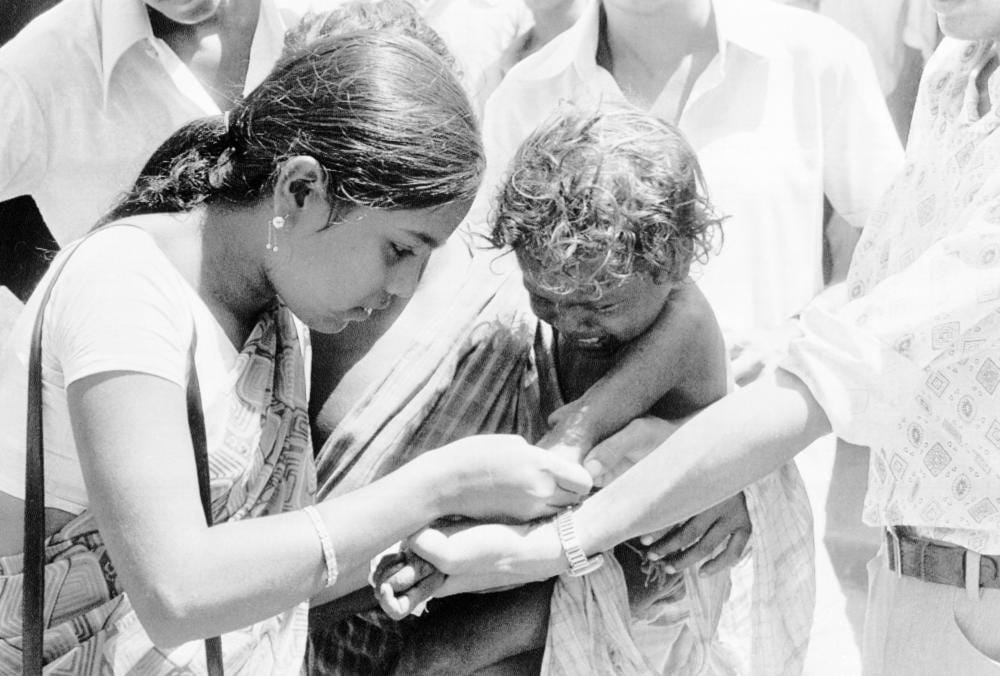
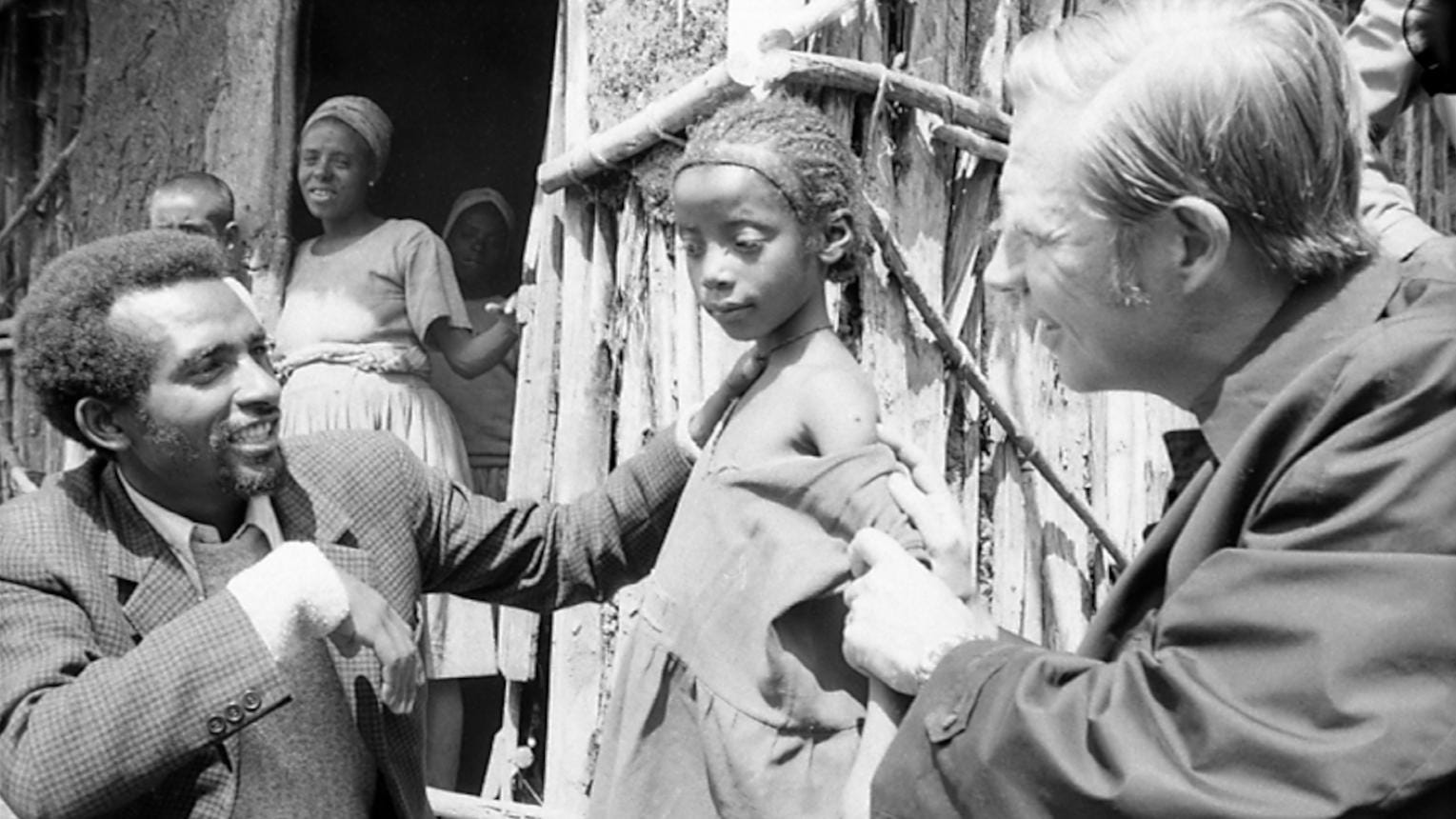
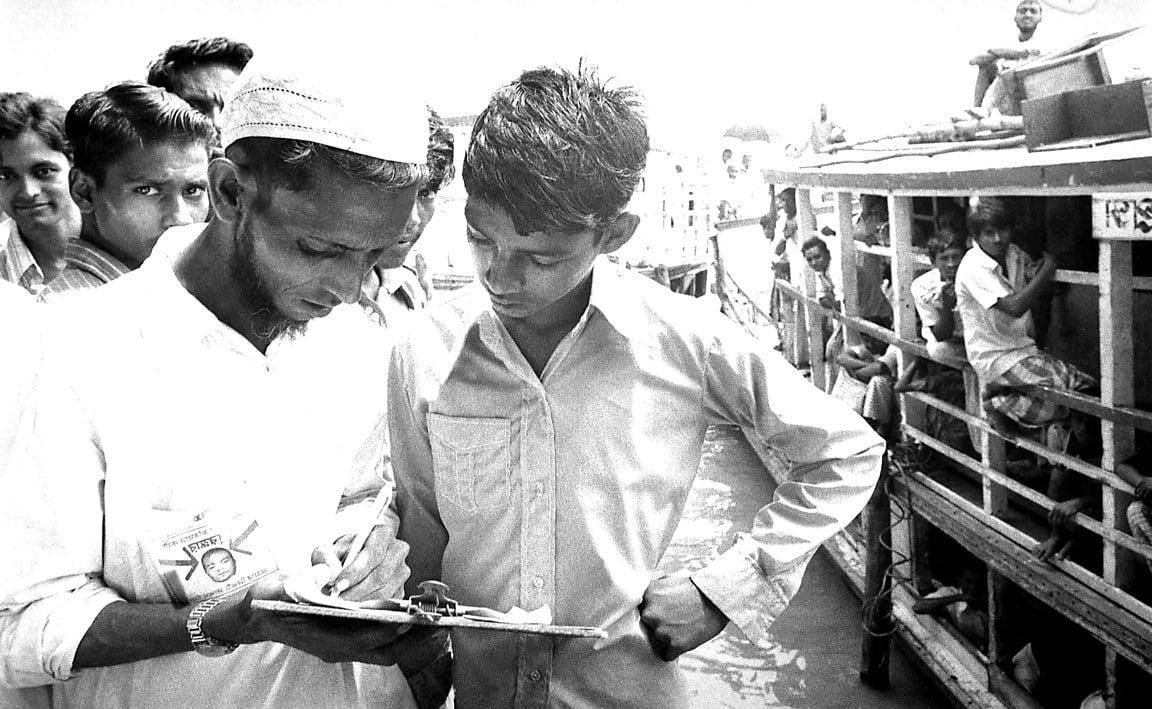
9
Historical photographs from the global effort to eradicate smallpox, including vaccination campaigns in India and Africa.
Smallpox terrorised humanity for thousands of years. It caused immense suffering, disfigurement and death. Communities were devastated; families lost children; entire populations lived under the threat of infection.
Edward Jenner developed the first successful smallpox vaccine in 1796. But scientific knowledge alone did not eradicate the disease.
Its elimination required international coordination, political commitment, health infrastructure, trained workers, surveillance, public trust and extraordinary dedication.
The World Health Organization intensified its eradication programme in 1967. The final naturally occurring case was recorded in Somalia in 1977. In 1980, WHO declared the disease eradicated.
Think about the significance of this accomplishment. A disease that had accompanied humanity for millennia was eliminated through collective human action.
Countries with different ideologies, religions, languages and political systems participated in the effort. Local healthcare workers and international organisations collaborated in the service of a shared objective.
The achievement was scientific, certainly. But it also required moral commitments: preventing avoidable suffering, protecting strangers and investing resources beyond immediate national interests.
Today, nobody needs to die from naturally circulating smallpox because earlier generations worked together.
The disease did not disappear merely because humanity wished it away. It disappeared because knowledge, political will, institutions and sustained action converged.
Can we imagine a comparable commitment to eradicating organised warfare?
The analogy is imperfect. Diseases have biological mechanisms, while wars emerge from political interests and institutional arrangements. Nevertheless, both cases raise the question of what coordinated human action can achieve when a destructive condition is no longer accepted as inevitable.

Representatives associated with the 1987 Montreal Protocol negotiations. Source: Canadian Meteorological and Oceanographic Society archives.
By the 1980s, scientists had established that certain industrial chemicals were damaging the Earth’s protective ozone layer. The problem was global. No nation could protect the atmosphere above its territory without international cooperation.
Governments therefore adopted the Montreal Protocol in 1987, establishing binding commitments to phase out ozone-depleting substances.
The agreement required industries to modify technologies, governments to coordinate regulations and countries to accept obligations whose benefits would extend across generations.
The United Nations Environment Programme reports that, assuming continued compliance, the ozone layer is expected to recover to approximately 1980 levels around 2040 for much of the world, 2045 in the Arctic and 2066 over Antarctica.
This is an extraordinarily important example of collective responsibility.
Humanity recognised a common threat, listened to scientific evidence, negotiated differences and established a practical mechanism for changing its behaviour.
The ozone layer belongs to no individual, corporation or nation. Protecting it required recognising a common good beyond immediate private interests.
The lesson is unmistakable: collective moral responsibility can become effective when translated into enforceable institutions and sustained cooperation.
Universal human rights: From national privilege to human dignity
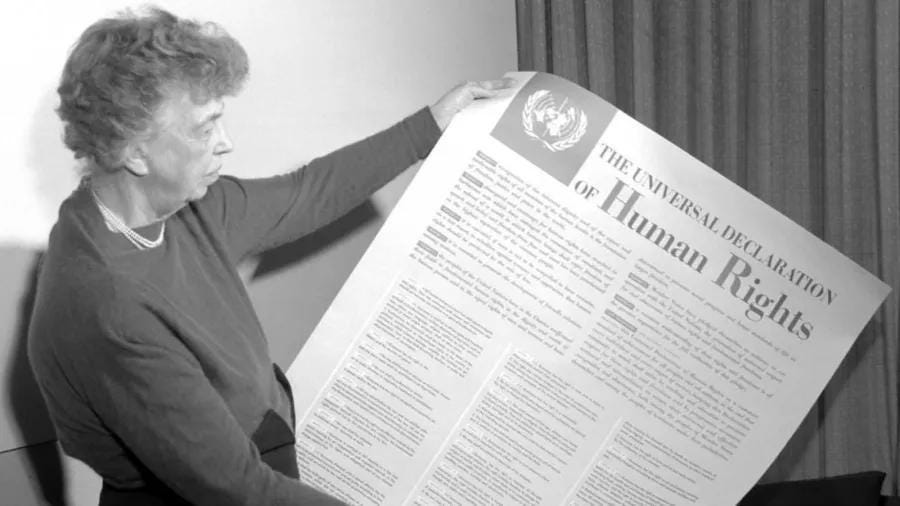
The Universal Declaration of Human Rights, adopted on 10 December 1948, represents another extraordinary development.
In the aftermath of the Second World War, representatives from different cultural, political and philosophical traditions sought to articulate rights belonging to human beings as such.
The Declaration established a common normative framework grounded in human dignity and equal rights. Its thirty articles addressed freedom, equality, security, political participation, education and social welfare.
It did not immediately prevent dictatorship, discrimination, exploitation or warfare. Indeed, its principles have often been violated by governments that publicly endorse them.
Nevertheless, it altered the language through which political legitimacy could be judged.
States could no longer plausibly argue, without challenge, that their treatment of citizens was entirely a matter of internal sovereign discretion.
The moral standing of the individual had acquired international recognition.
These three achievements—smallpox eradication, ozone protection and human rights—illustrate different mechanisms of collective advancement. They should not be confused. The first was a public-health accomplishment, the second an environmental governance achievement, and the third a normative and legal development.
But they share an important feature: they required people to imagine obligations extending beyond immediate personal or national interests.
How collective transformation becomes possible
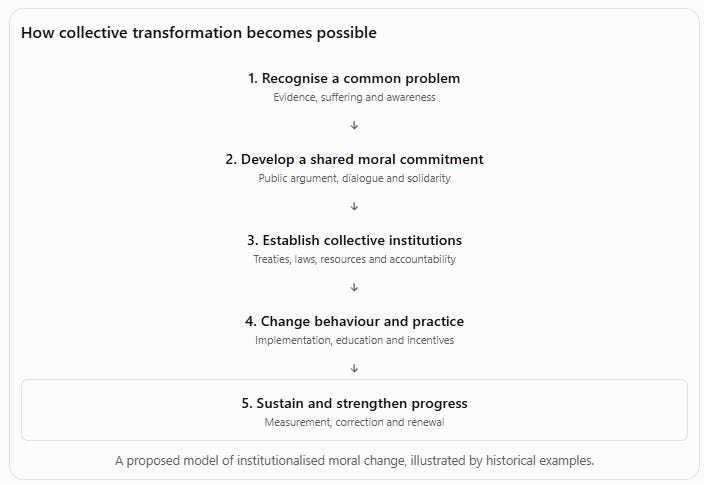
If such coordinated action is possible, our failure to cooperate in other areas cannot be explained by human nature alone. We must also examine political choices, economic incentives, institutional weaknesses and the stories societies tell about what is possible.
7. Expanding the Moral Circle: From Me to We to All
Perhaps the most important feature of advancing moral consciousness is the widening of our concern.
We begin life dependent on particular persons: parents, relatives, caregivers and communities. Our earliest moral attachments are concrete and immediate. We learn to care for those who care for us.
But moral maturity requires us to recognise that the dignity of others does not depend on their closeness to us.
The stranger also matters.
The poor person whose suffering we never witness matters.
The worker producing goods in a distant country matters.
The child yet to be born matters.
And the ecological systems upon which life depends cannot be treated simply as limitless instruments for satisfying present human desires.
Peter Singer’s The Expanding Circle (1981) offers one influential account of the extension of moral concern beyond narrow affiliations. Martha Nussbaum’s capabilities approach similarly directs attention to the substantive conditions people require in order to live lives worthy of human dignity (Creating Capabilities, 2011).
These arguments resonate with my own emphasis on all-inclusive ethics. An ethical civilisation cannot be constructed around an ever-shrinking definition of those who deserve consideration.
At the same time, moral inclusion must not be confused with moral uniformity. Cultural, philosophical and religious differences are valuable dimensions of human life. The objective is not to eliminate difference, but to ensure that difference does not become an excuse for domination.
An expanding horizon of responsibility
The circle widens without extinguishing our particular commitments.
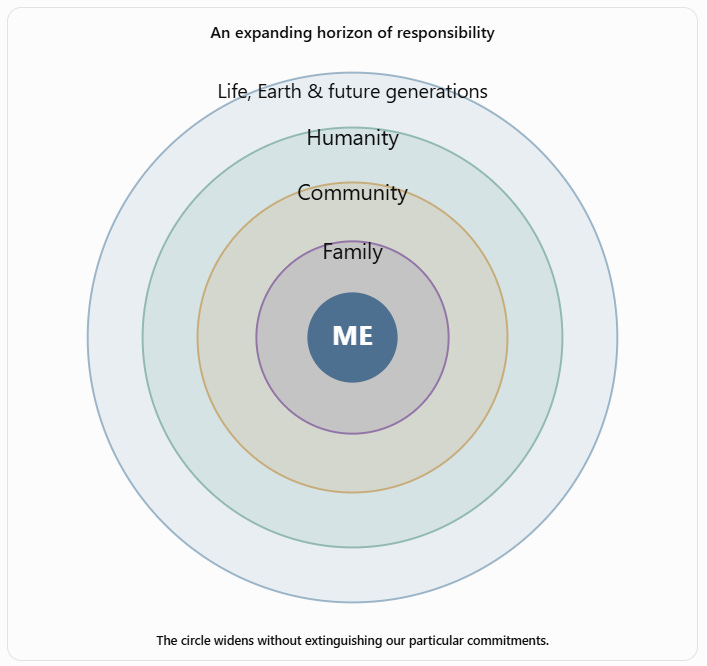
The Sanskrit expression vasudhaiva kuṭumbakam—the world as one family—offers a powerful ethical image. Yet it must become more than a slogan displayed at international gatherings. Its credibility depends on how societies treat refugees, minorities, vulnerable communities and populations beyond their borders.
A planetary moral consciousness cannot coexist comfortably with extreme indifference to preventable suffering.
It asks us to accept a demanding proposition: the interests of our own group are important, but they are not the only interests that matter.
8. Moral Progress Is Neither Automatic Nor Irreversible
We must resist the temptation to make progress sound inevitable.
History offers too much evidence to the contrary.
The same twentieth century that witnessed remarkable expansion in human rights also produced the Holocaust, genocides, totalitarian repression and the development of nuclear weapons. Scientific sophistication did not prevent barbarism. In some circumstances, it enabled barbarism to become more systematic and destructive.
Theodor Adorno’s writings on education after Auschwitz remind us that intellectual cultivation without resistance to cruelty and authoritarianism remains tragically inadequate.
Steven Pinker, in The Better Angels of Our Nature (2011), presents extensive historical arguments concerning declines in various forms of violence. His work challenges the widespread assumption that the past was necessarily more peaceful than the present.
Yet John Gray and other critics of historical progress narratives have warned against treating contingent political achievements as evidence of an inevitable moral trajectory.
I find it important to distinguish three propositions.
First, some forms of violence and injustice have declined in particular societies and periods.
Second, humanity has developed increasingly ambitious moral standards, laws and institutions.
Third, the future will necessarily be morally better than the past.
The first two propositions can be supported by evidence, although their scope and interpretation require care. The third does not follow from them.
We may advance morally in one domain while deteriorating in another. We may abolish one injustice while creating technological conditions for new forms of exploitation. We may achieve considerable equality before the law while tolerating severe material inequalities.
Recent developments underscore this fragility. Nuclear-armed states are modernising their arsenals, and SIPRI’s 2026 assessment warns of heightened risks of escalation and miscalculation.
Humanity may know more about the dangers of nuclear weapons than ever before, yet remain politically unable to abandon them.
The growth of knowledge, therefore, must not be confused with the growth of conscience.
We have no historical guarantee of moral progress. Precisely for that reason, we have a moral responsibility to pursue it.
9. How Can Humanity Advance Its Moral Consciousness?
It is easy to speak of moral improvement. It is considerably more difficult to explain how such improvement can be achieved.
A serious programme of moral development must operate simultaneously at personal, educational, institutional, economic and planetary levels. It cannot depend exclusively on goodwill. Nor can legislation alone produce compassionate individuals.
I propose ten mutually reinforcing commitments through which we can advance our collective moral consciousness.
First, we must learn to recognise suffering beyond our immediate experience
Moral indifference frequently begins with distance. We may feel deep concern for the suffering of a family member while remaining largely unmoved by the suffering of strangers.
Education, literature, history, personal encounters and responsible journalism can help overcome this moral distance.
But empathy alone is not enough. It is selective, emotionally fragile and sometimes manipulated. We must join compassionate identification with reasoned commitments to fairness and human dignity.
A society becomes morally mature when it protects people not simply because its members sympathise with them, but because it recognises that they are entitled to protection.
Second, education must cultivate conscience as well as competence
We invest enormous resources in teaching people to become engineers, managers, physicians, scientists and technological specialists. Yet we devote comparatively less systematic attention to helping them ask what their knowledge should ultimately serve.
A medical student must learn how to treat disease, but also how to respect a patient’s dignity. A business student must understand profitability, but also recognise exploitation and environmental responsibility. An engineer must understand technological efficiency, but also anticipate the human consequences of technical decisions.
Moral education cannot be reduced to lectures on good behaviour. It requires philosophical discussion, case analysis, encounters with ethical dilemmas, historical reflection and opportunities for responsible action.
It should encourage students to question prevailing conventions, including the values of the institutions educating them.
The educated person must not merely be able to solve problems. That person must also learn to ask whether the problems being solved are worth solving, whose interests are being served and what consequences may follow.
Third, we must cultivate the courage to question accepted injustices
Many moral transformations begin with a minority refusing to accept what the majority regards as normal.
Abolitionists questioned slavery. Suffragists challenged political exclusion. Gandhi confronted the political legitimacy of colonial domination. Ambedkar rejected the moral legitimacy of caste hierarchy and demanded a social order grounded in equal citizenship.
Their contributions remind us that moral progress often depends on dissent.
Democratic societies therefore require more than electoral procedures. They require freedom of expression, intellectual independence, protection of minorities and an ethical culture in which criticism is not immediately treated as disloyalty.
The capacity to say no to injustice may be one of the most important manifestations of moral maturity.
Fourth, moral convictions must become institutions
Individual goodness cannot compensate indefinitely for unjust structures.
A compassionate manager cannot fully remedy exploitative labour arrangements without changing organisational policies. A sympathetic citizen cannot guarantee universal healthcare without suitable institutions. A peaceful population cannot secure itself against aggression without credible mechanisms for conflict prevention and collective security.
Moral progress becomes durable when values are embodied in institutions.
Human rights must become enforceable protections. Environmental concern must shape legislation and industrial practice. Corporate responsibility must influence governance, incentives and accountability.
We must judge an institution not merely by the ideals it proclaims, but by the consequences of its normal operations.
Fifth, we must replace the glorification of war with a culture of peace
This is particularly urgent.
Children are frequently taught to celebrate military victories while receiving relatively little education in conflict resolution, reconciliation and the prevention of violence.
We should not deny the courage of those who protect communities from aggression. But courage in defence must be distinguished from the glorification of violence itself.
Imagine educational systems that gave the history of successful peace agreements, nonviolent movements and international cooperation the same seriousness as the history of wars.
Imagine political leadership judged not by the number of enemies defeated, but by the number of conflicts prevented and lives preserved.
Such changes would not abolish war immediately. They could, however, alter the cultural assumptions that make warfare appear admirable or unavoidable.
Sixth, economic progress must become compassionate and inclusive
A civilisation cannot plausibly claim moral maturity while treating human beings merely as units of labour, consumers or instruments of profit.
Business organisations possess enormous capacities to shape employment, communities, technological innovation and ecological conditions. These capacities bring corresponding responsibilities.
Compassionate capitalism, as I understand it, does not reject markets or entrepreneurial initiative. It asks whether economic institutions can combine innovation and efficiency with human dignity, solidarity, fair opportunity and responsibility towards the vulnerable.
Profitability remains important. It cannot, however, become the sole criterion of organisational excellence.
The relevant question is not simply whether wealth is created, but how it is created, who benefits from it and what costs are transferred to others.
Seventh, technology must be governed by moral responsibility
AI, biotechnology, digital surveillance and autonomous systems require institutional safeguards that match their potential consequences.
This demands responsible design, meaningful human accountability, transparency, rigorous assessment of foreseeable harm and protections against concentrations of unchecked technological power.
An ethical technology policy should not merely ask whether innovation produces economic value. It should ask whether it preserves human agency, protects the vulnerable, strengthens democratic institutions and serves the common good.
We need technological intelligence. But intelligence must remain answerable to conscience.
Eighth, ecological responsibility must become a moral imperative
Our understanding of responsibility has expanded beyond contemporaries towards future generations.
Environmental destruction demonstrates that human beings can impose serious burdens on people who cannot yet participate in political decisions.
Hans Jonas, in The Imperative of Responsibility (1984), argued that modern technological power creates new obligations towards the future of human life.
This insight requires us to reconsider consumption, production, energy systems and the moral significance of ecological dependence.
The Earth is not simply a warehouse of resources awaiting exploitation. It is the condition that makes our existence possible.
Ninth, we must learn to disagree without dehumanising
A morally developed civilisation need not be a civilisation without disagreement. Philosophical plurality, religious diversity and political opposition can enrich human understanding.
The problem arises when disagreement becomes a justification for denying another person’s dignity.
Habermas’s theory of communicative action reminds us that social cooperation requires practices of reason-giving, mutual recognition and dialogue.
We must recover the capacity to distinguish between criticising an argument and humiliating a person, opposing a political position and treating its supporters as enemies, or defending one’s convictions and refusing to examine them.
Moral consciousness advances when disagreement becomes an opportunity for understanding rather than a preparation for hostility.
Tenth, we must make planetary solidarity politically meaningful
No country can independently secure the global climate, prevent all pandemics, govern transnational AI systems or eliminate the risks of nuclear war.
Our interdependence has become an empirical reality.
Our institutions and moral imagination have not fully caught up with it.
Planetary solidarity requires cooperation that is more substantial than diplomatic declarations. It calls for credible international institutions, fair sharing of responsibilities, protection of weaker states, and sustained commitments to the common good.
It also requires recognising that moral obligations do not end at national borders.
The challenge is not to abolish national identities, but to prevent them from exhausting our moral commitments.
A practical architecture of moral advancement
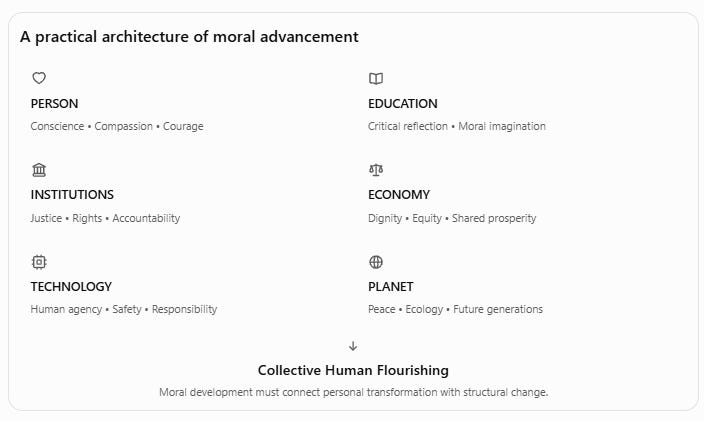
Moral development must connect personal transformation with structural change.
10. Can We Measure Moral Progress?
Our societies devote considerable attention to measuring economic growth, educational attainment, productivity, innovation and technological advancement.
We develop indicators of national income, life expectancy, research output, industrial performance and digital connectivity.
These measurements are useful, but incomplete.
A country may achieve remarkable technological sophistication while maintaining severe inequalities. Another may enjoy rising national income while tolerating discriminatory institutions. A society may become increasingly efficient without becoming more just.
Should we not also attempt to measure the moral conditions of collective life?
Such measurement would be difficult. Moral values are contested, societies differ in their traditions, and moral consciousness cannot be reduced to a single numerical index.
Nevertheless, observable changes in institutions, rights and behaviour can provide meaningful evidence of moral development.
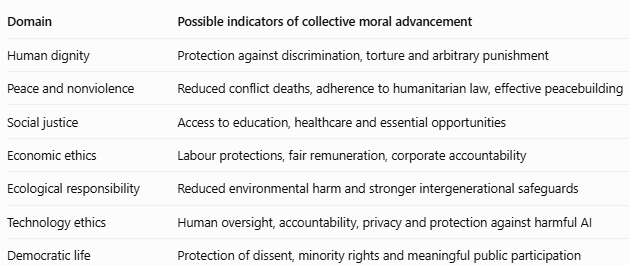
These indicators should never be treated as a definitive ranking of the moral worth of peoples or cultures. They are better understood as diagnostic instruments that reveal whether societies are strengthening or weakening particular conditions of human flourishing.
The purpose of measurement must be ethical self-examination, not civilisational self-congratulation.
For instance, UNESCO reported in 2026 that approximately 273 million children and young people remained out of school worldwide. Despite substantial gains in enrolment since 2000, educational exclusion remains a serious challenge.
This reminds us that progress must be assessed in terms of both achievements and unmet obligations.
The crucial question is not whether humanity can produce impressive statistics. It is whether measurable improvements in our institutions correspond to more dignified, just and humane lives.
11. Towards a Planetary Moral Consciousness

Earthrise, photographed during Apollo 8 in December 1968. A powerful image of our shared and vulnerable planetary home.
Few images have transformed humanity’s imagination as powerfully as photographs of the Earth seen from space.
From that distance, national borders disappear. The divisions that dominate so much of political life become invisible. What remains is a small, luminous planet surrounded by darkness.
Of course, photographs alone cannot overcome political conflict. But they can invite us to recognise something morally significant: humanity shares a common habitat, a common vulnerability and an increasingly interconnected destiny.
Pierre Teilhard de Chardin’s reflections on the noosphere offer one way of approaching this transformation. For Teilhard, the development of reflective thought and human interconnection suggested that evolution had acquired a new dimension through consciousness.
One need not accept every aspect of his evolutionary theology to appreciate the philosophical insight: humanity’s growing interconnectedness creates possibilities for deeper forms of collective awareness.
Yet communication is not identical with communion.
We may be technologically connected without becoming morally united. We may share information without sharing responsibility. We may develop global networks that increase mutual dependence while intensifying suspicion and competition.
This distinction is decisive.
A planetary moral consciousness would not require the disappearance of cultures, religions or national identities. It would require recognition that some obligations arise simply because we share a world.
We must learn to think of humanity as a moral community without pretending that humanity is a culturally uniform community.
Pope Francis, in Fratelli Tutti (2020), developed a vision of social friendship and fraternity that resists the narrowing of concern to one’s own group. The encyclical is particularly attentive to the excluded, the migrant and the stranger.
Ambedkar’s insistence on liberty, equality and fraternity similarly reminds us that social solidarity cannot be genuine when it coexists with systematic humiliation and exclusion.
And Gandhi’s understanding of nonviolence challenges us to recognise that the means through which we pursue justice must themselves be subject to moral scrutiny.
I would bring these voices into conversation with the philosophical conviction that has shaped much of my work: we are relational beings whose existence is constituted not merely by individual achievements, but by the relationships and responsibilities through which we encounter one another.
We do not flourish alone.
Our dignity is personal, but the conditions of flourishing are profoundly social.
Our freedom matters, but freedom cannot be separated entirely from the freedom and vulnerability of others.
Our future matters, but we cannot secure it by remaining indifferent to the future of humanity as a whole.
12. Humanity’s Best or Last Generation?

In Hope in/for Humanity: Becoming the Best Generation by Addressing Global Challenges Through Ethical Consciousness, I developed the possibility that our generation might become one of humanity’s finest by addressing the crises confronting us through ethical responsibility.
The same thought carries a disturbing qualification: our generation also possesses capacities capable of causing unprecedented harm.
Hope, therefore, must become a disciplined commitment to action, rather than an expectation that events will somehow turn out well.
Earlier generations confronted famine, disease, oppression and warfare without possessing many of the scientific resources available to us today.
We now have technologies that could substantially improve human well-being. We also possess destructive capacities that earlier generations could scarcely imagine.
Our situation is historically unusual.
We are not merely inheritors of civilisation. We are becoming increasingly capable of influencing the conditions under which civilisation itself can survive.
Artificial intelligence sharpens this responsibility.
As AI systems become more capable, they may assist humanity in discovering medicines, expanding education, improving public administration and understanding complex ecological systems.
But they may also accelerate warfare, automate exploitation, concentrate power and undermine human freedom.
The ultimate question is not whether AI will become sufficiently intelligent.
It is whether humanity will become sufficiently wise.
If we cannot resolve the moral contradictions already present in our economic and political institutions, increasingly powerful technologies may amplify rather than overcome them.
We must therefore resist the temptation to look towards technology as a substitute for moral responsibility.
Machines may help us make better decisions. They cannot relieve us of the obligation to decide what kind of world those decisions should create.
The responsibility remains ours.
13. The Next Revolution Must Be Moral
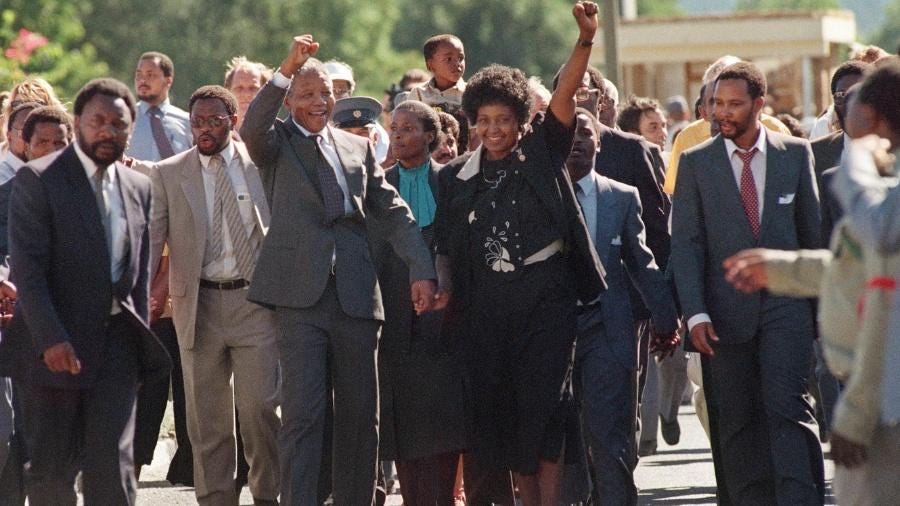
Nelson Mandela’s release in 1990 became a defining image of the struggle against apartheid and the possibility of political transformation.
Let me return to the historical argument with which I began.
Our ancestors inhabited societies in which slavery was accepted, women were denied political participation, colonial conquest was defended as a legitimate enterprise, and public executions were part of civic life.
These practices did not disappear because human beings suddenly became perfectly virtuous. They were challenged through moral arguments, public resistance, institutional changes and sustained collective action.
Nor has their abolition eliminated every form of injustice associated with them.
But the fact remains that humanity has demonstrated a remarkable capacity to reconsider what it once regarded as normal.
We are not permanently imprisoned within the moral assumptions of our ancestors.
Why, then, should our descendants remain imprisoned within ours?
Imagine a future generation looking back upon our civilisation.
It might be astonished that we possessed the scientific knowledge to feed and educate far more people than ever before, yet tolerated severe deprivation.
It might struggle to understand why societies capable of instantaneous global communication continued to cultivate hatred across national, religious and cultural boundaries.
It might find it extraordinary that we devoted immense resources to weapons of destruction while claiming that the pursuit of peace was unrealistic.
Perhaps, most importantly, it might wonder why we considered ourselves technologically advanced while remaining so uncertain about how to live together.
These questions are not intended to condemn humanity. They are intended to awaken possibilities.
What we now accept as inevitable may eventually become unacceptable.
What we dismiss as utopian may become an organising principle of future institutions.
What begins as the moral conviction of a minority may eventually reshape the conscience of humanity.
But this transformation will not happen automatically.
It will require moral imagination, courageous leadership, education, democratic participation, responsible economic institutions, technological restraint and political cooperation.
We must make collective moral development an explicit civilisational objective.
We have learned to fly, but not always to embrace. We have learned to communicate across continents, but not always to understand one another. We have learned to prolong life, but we continue to develop increasingly sophisticated instruments for destroying it.
We have even created machines that imitate aspects of human intelligence. Yet we have not fully learned to overcome the greed, violence, prejudice and indifference that compromise our common life.
The achievements of science and technology are immense. We should celebrate them. But they will remain morally incomplete unless they contribute to a more just and compassionate civilisation.
Perhaps the greatest achievement of the twenty-first century will not be the creation of another extraordinary machine, the conquest of another technological frontier or the accumulation of unprecedented wealth.
Perhaps it will be the recognition that no human being is expendable, that no community is outside our moral concern, and that war need not remain an accepted instrument of political life.
The future of humanity will depend not only on what we discover, invent or produce.
It will depend on what we collectively learn to value, what we refuse to tolerate, and what we choose to become.
Moral Progress Is Possible.
Moral Progress Is Necessary.
Moral Progress Is Our Responsibility.
Our collective survival and flourishing depend on advancing our collective moral consciousness.
Selected References and Further Reading
Aristotle. (1998). Politics (C. D. C. Reeve, Trans.). Hackett Publishing.
Ambedkar, B. R. (2014). Annihilation of Caste: The Annotated Critical Edition (S. Anand, Ed.). Navayana. (Original work published 1936).
Amnesty International. (2026). Death sentences and executions 2025. Annual report
Francis. (2020). Fratelli Tutti: On Fraternity and Social Friendship. Vatican.
Gilligan, C. (1982). In a Different Voice: Psychological Theory and Women’s Development. Harvard University Press.
Habermas, J. (1984). The Theory of Communicative Action, Volume 1 (T. McCarthy, Trans.). Beacon Press.
Jonas, H. (1984). The Imperative of Responsibility: In Search of an Ethics for the Technological Age. University of Chicago Press.
Kant, I. (1996). Practical Philosophy (M. J. Gregor, Ed. & Trans.). Cambridge University Press. (Includes Groundwork of the Metaphysics of Morals and Toward Perpetual Peace.)
Nussbaum, M. C. (2011). Creating Capabilities: The Human Development Approach. Harvard University Press.
Pandikattu, K. (2022). Ethics, Artificial Intelligence and Human Destiny: Our Collective Search. Christian World Imprints.
Pandikattu, K. (2024). Hope in/for Humanity: Becoming the Best Generation by Addressing Global Challenges Through Ethical Consciousness. JRD Tata Foundation for Business Ethics. DOI
Pandikattu, K. (2026). AI Can Help, Not Save Us: Human Dignity, and the Moral Revolution We Still Need. Carmel International Publishing House.
Pandikattu, K. (Ed.). (2025). Applied Ethics and Rationality: Contemporary Indian Perspectives. Springer. Publisher edition
Pinker, S. (2011). The Better Angels of Our Nature: Why Violence Has Declined. Viking.
Singer, P. (1981). The Expanding Circle: Ethics and Sociobiology. Farrar, Straus and Giroux.
Stockholm International Peace Research Institute. (2026). SIPRI Yearbook 2026. Research and data
United Nations. (1948). Universal Declaration of Human Rights. Official declaration
United Nations Environment Programme. (2023). Scientific Assessment of Ozone Depletion: 2022. World Meteorological Organization.
World Health Organization. (1980). Declaration of Global Eradication of Smallpox. WHO historical overview
"Moral progress is possible, but it is never secure"
This was long and enriching read professor. Moving to the vantage point which allows us to take morality not just as individual conception but rather something that is shared across the brotherhood of mankind is what makes us move closer to ideal moral superiority.