

1. We Are Connected as Never Before. Why Do We Feel So Divided?
We live in a remarkable and paradoxical age. Never before have human beings been so closely connected, technologically capable and materially empowered. We communicate across continents instantaneously, travel vast distances within hours, and access an almost inexhaustible storehouse of human knowledge through the devices we carry in our pockets. Medicine has prolonged life, scientific inquiry has expanded our understanding of the universe, and artificial intelligence is beginning to alter the very conditions of human thought and action.
Yet something remains disturbingly incomplete about our civilisation.
We communicate more, but do we understand one another better? We accumulate information, but do we grow in wisdom? We have become extraordinarily successful at connecting machines and markets, but remain surprisingly unsuccessful at connecting hearts and minds.
Our religious traditions speak of compassion, forgiveness, love, justice and peace. Nevertheless, religion continues to become entangled with exclusion, political domination, inherited prejudice and even violence. We affirm the sacredness of human life while sometimes remaining indifferent to the suffering of those who belong to another community, caste, religion or nationality.
Meanwhile, millions who are uncomfortable with institutional religion continue to search for meaning, transcendence and spiritual depth. Some turn towards meditation, yoga, silence, nature, poetry or service. Others turn towards self-help movements that promise inner peace, personal success or happiness.
But can spirituality be reduced to feeling peaceful? Is its purpose simply to improve our emotional well-being, increase our productivity or help us cope with an increasingly demanding world?
I do not think so.
Spirituality, at its most authentic, is a radical reorientation of the human person. It changes how we understand ourselves, how we encounter others, how we relate to suffering, how we interpret the mystery of existence and how we assume responsibility for the world we inhabit.
In my book Inclusive Spirituality: Embracing Misery, Majesty, and Mystery, I have explored the possibility of a spirituality sufficiently expansive to embrace the whole of human existence rather than selected experiences that make us comfortable.
In Decode Your Why: Unlocking Meaning, Mystery and Majesty through Inclusive Spirituality, I have pursued a closely related question: What enables human beings to live meaningfully amid suffering, uncertainty, freedom, responsibility and the unavoidable mystery of existence?
Both books emerge from a conviction that has accompanied much of my philosophical, theological and scientific reflection.
We become more authentically ourselves not by withdrawing from others, but by entering more deeply into the relationships that constitute our humanity.
Inclusive spirituality begins with this recognition.
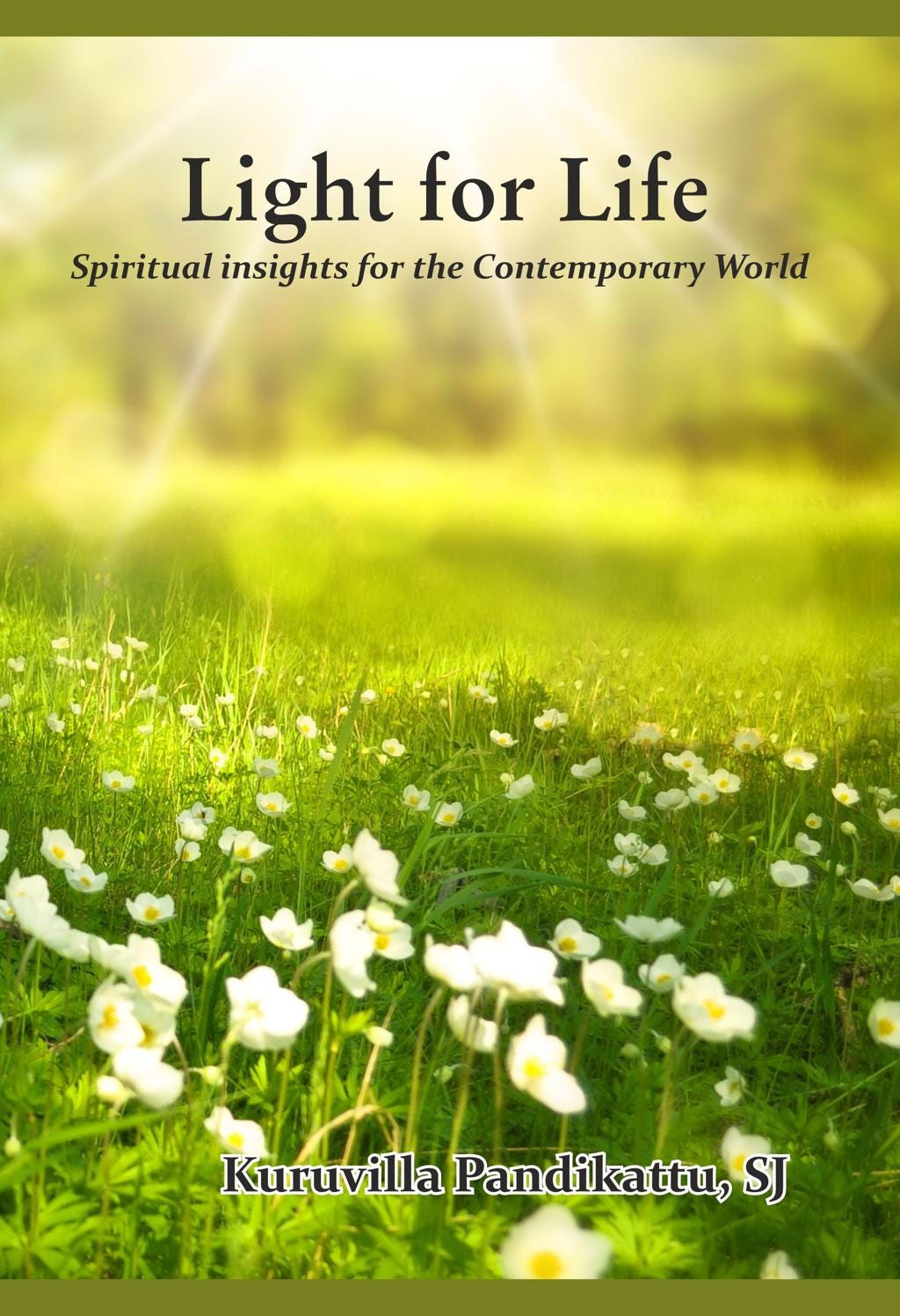
Inclusive Spirituality: Embracing Misery, Majesty, and Mystery
Kuruvilla Pandikattu, 2024
The book examines spirituality through three inseparable dimensions of human existence: our vulnerability to suffering, our extraordinary capacity for dignity and wonder, and the mystery that exceeds our understanding.
Full book: Read the publication
2. What Makes Spirituality Inclusive?
The word inclusive is widely used today. We speak of inclusive education, inclusive organisations, inclusive growth and inclusive leadership. Yet the meaning of inclusion is often reduced to the presence of diverse people within the same institution.
Spiritual inclusion demands something more substantial.
It requires us to reconsider the boundaries through which we recognise dignity, belonging, truth and moral responsibility.
A person may be religiously observant but spiritually exclusive. One may faithfully participate in rituals while refusing to acknowledge the humanity of those who worship differently. Conversely, a person who rejects traditional religious beliefs may demonstrate extraordinary moral seriousness, compassion and reverence for life.
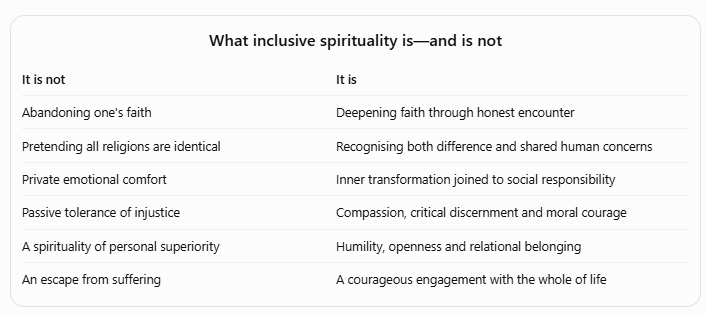
This observation does not imply that all religious traditions are identical, that theological differences are insignificant, or that personal convictions must be abandoned in the name of harmony.
An inclusive spirituality that demands the surrender of conviction would merely replace one form of intolerance with another.
The challenge is subtler. Can I remain deeply rooted in my own tradition while respecting the integrity of another person’s different understanding of ultimate reality? Can I affirm what I hold to be true without treating those who disagree as spiritually inferior? Can I learn from other traditions without appropriating them, trivialising their differences or dissolving them into a convenient mixture?
I believe we can.
Inclusive spirituality is not the rejection of religious identity. It is the refusal to make religious identity the outer limit of compassion, dialogue and responsibility.
As a Jesuit, my own spiritual imagination is profoundly shaped by the Christian understanding of love, the dignity of the human person and the Ignatian invitation to discover divine presence within ordinary existence.
Yet my engagement with Hindu, Buddhist, Jain, Sikh, Islamic, tribal and secular humanistic traditions has convinced me that genuine encounter need not weaken religious commitment. It can deepen self-understanding, expose blind spots and expand the possibilities of compassionate action.
Such openness does not require us to pretend that traditions agree about God, the self, salvation, liberation or ultimate reality. They do not.
It does require us to acknowledge that our interpretations are historically situated, our understanding remains finite and our encounters with others may disclose dimensions of reality we have previously neglected.
What inclusive spirituality is - and is not
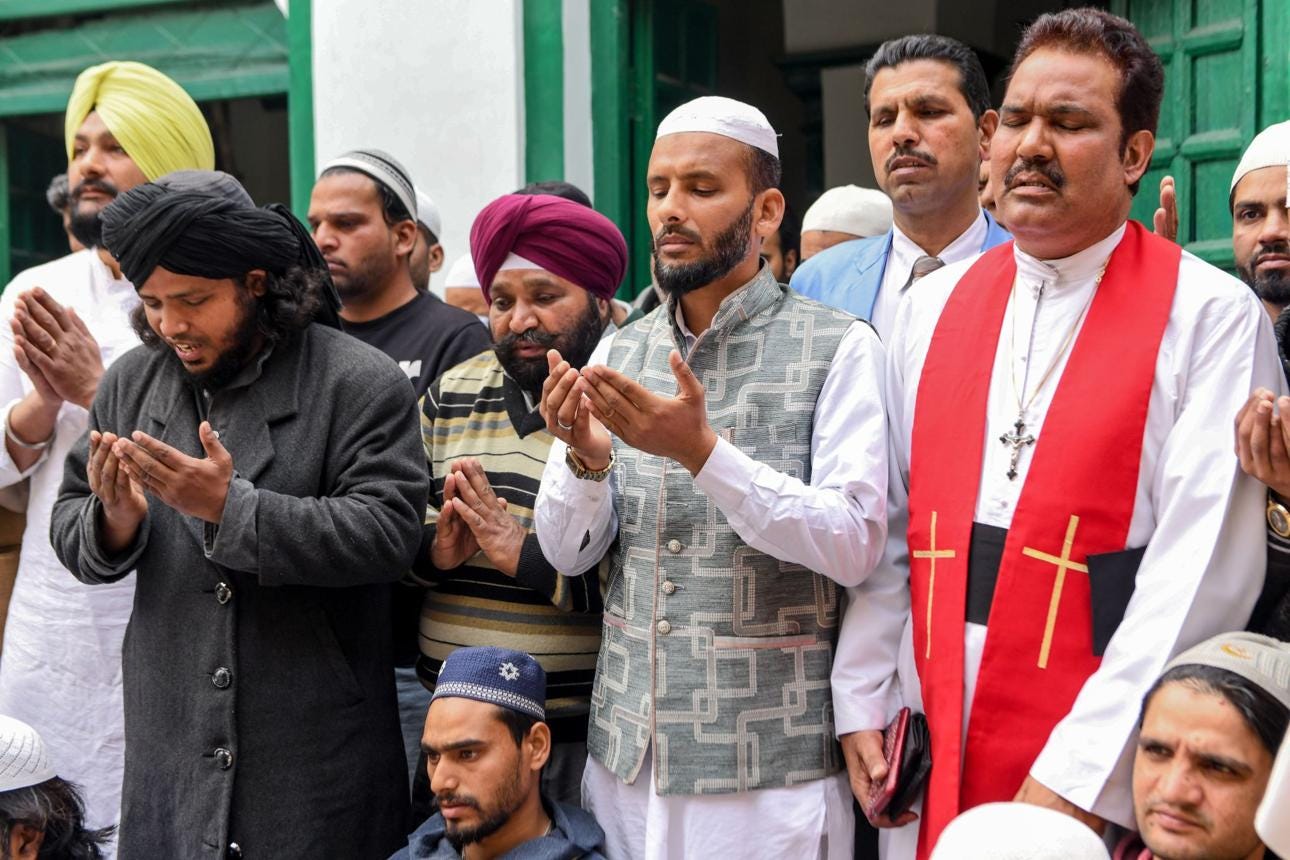
The decisive movement is from possession towards participation. Truth is not simply something we claim to possess; it is also something that challenges, judges and transforms us.
Religious certainty becomes dangerous when it exempts itself from moral criticism. Spiritual openness becomes superficial when it refuses to take truth seriously.
Inclusive spirituality must resist both dangers.
3. Misery: The Spirituality That Does Not Look Away
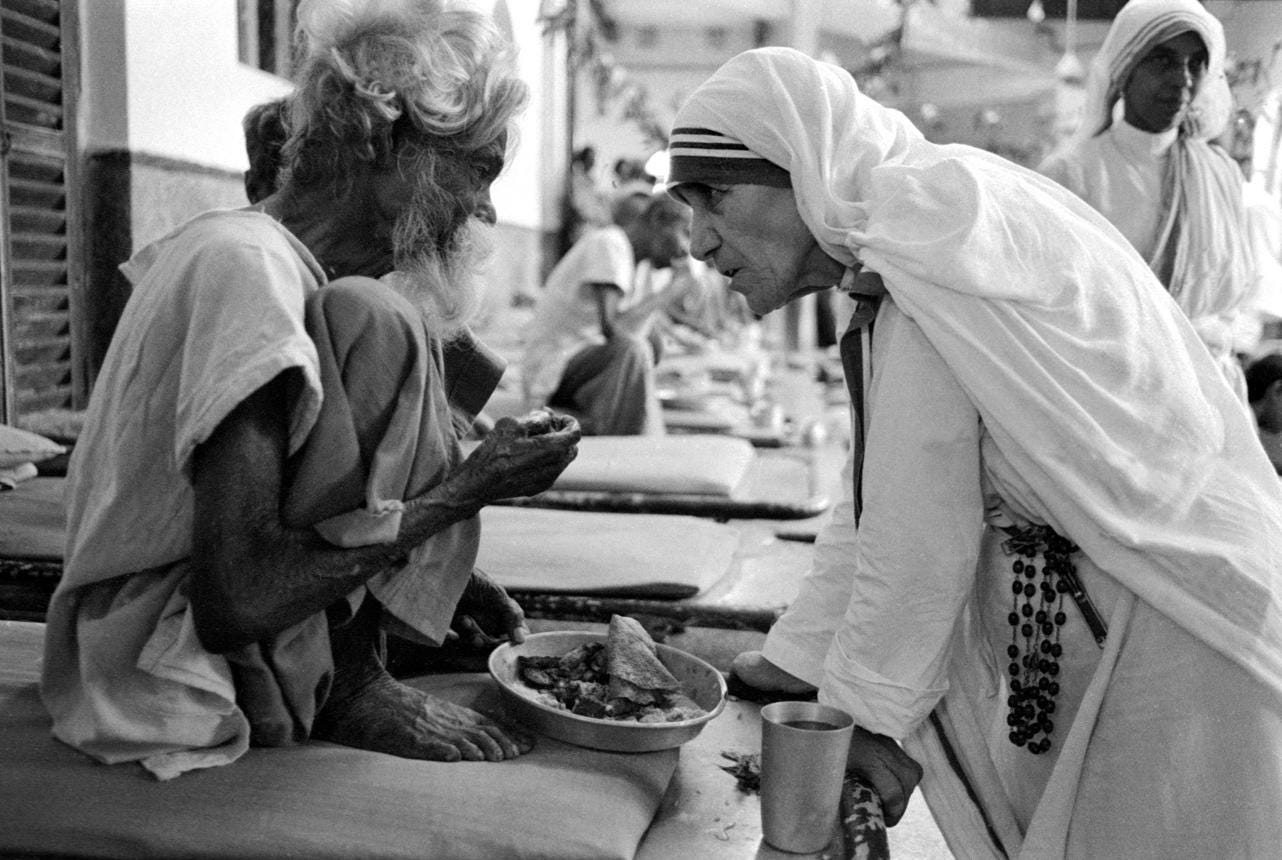
Any spirituality worthy of serious consideration must begin with the reality of suffering.
Human life is vulnerable. We experience illness, disappointment, rejection, loneliness, failure, betrayal, ageing and death. We witness the suffering of people whom we love, and sometimes the suffering of strangers whose circumstances challenge our understanding of justice.
No amount of technological advancement can eliminate every dimension of vulnerability. Medical science can alleviate enormous suffering, but it cannot remove the existential conditions of finitude, uncertainty and mortality.
One of the weaknesses of contemporary spiritual consumerism is its tendency to treat suffering primarily as an inconvenience to be managed. We are encouraged to remain positive, cultivate pleasant emotions, visualise success and protect our peace.
Such practices may have legitimate psychological value. But suffering cannot always be transformed through changes in personal attitude.
Poverty is not merely a problem of negative thinking. Discrimination is not simply an opportunity for spiritual growth. Violence cannot be adequately addressed by asking its victims to become more resilient.
Inclusive spirituality must distinguish between suffering that belongs to our finite human condition and suffering produced or intensified by unjust human institutions.
The first calls for compassion, courage and accompaniment. The second additionally demands resistance, reform and accountability.
The Buddha’s teaching begins with the reality of dukkha, the unsatisfactoriness and vulnerability that permeate conditioned existence. Buddhist practice seeks liberation through wisdom, ethical discipline and compassion.
Christian spirituality places suffering at the centre of its understanding of redemption, particularly through the life, death and resurrection of Jesus. But the cross must never be used to romanticise oppression or justify the avoidable suffering of vulnerable people.
Gandhi’s moral and political life demonstrated that suffering could become a form of disciplined resistance to injustice. Yet even here, we must distinguish voluntary sacrifice from suffering imposed upon others.
These differences matter. Nevertheless, they converge on an important practical insight: turning away from suffering does not make us spiritually mature.
Spirituality begins when we become capable of remaining present before vulnerability without surrendering compassion or abandoning responsibility.
Consider the ordinary experience of visiting a seriously ill person. We may arrive wanting to offer advice, explanations or reassurance. Yet what the person sometimes needs most is neither an explanation nor a solution, but another human being willing to remain present.
A hand held in silence, a patient conversation, a refusal to abandon someone whose situation cannot be repaired—these can become expressions of considerable spiritual depth.
The same principle operates socially. A society’s spiritual maturity cannot be measured merely by the number of religious buildings it constructs or the scale of its public rituals.
It must also be judged by the way it treats those who suffer.
How are elderly people cared for? What happens to persons living with disabilities? Are the poor respected or humiliated? Are prisoners regarded as human beings? Are refugees and displaced communities met with compassion or hostility?
Such questions bring spirituality into the uncomfortable territory of social ethics.
That is precisely where it belongs.
4. Majesty: Rediscovering the Extraordinary Within the Ordinary

The Cosmic Cliffs in the Carina Nebula, captured by the James Webb Space Telescope. Scientific discovery can become an invitation to wonder.
Human existence is not merely tragic. It is also astonishing.
We inhabit a universe whose vastness exceeds ordinary imagination. Our bodies emerge from extraordinarily intricate biological processes. The human brain enables language, memory, creativity, reasoning and moral reflection. Through scientific inquiry, we have begun to understand processes extending from subatomic particles to galaxies billions of light-years away.
I have spent much of my intellectual life engaging the relationship between science, philosophy and religion. What continues to impress me is not simply the amount of knowledge humanity has accumulated, but the remarkable fact that a finite being can understand anything at all about such an immense universe.
Why is reality intelligible? Why do mathematical relationships describe physical phenomena? Why should consciousness emerge within the evolutionary history of life? Why do beauty, truth and goodness matter to beings who could apparently survive through more immediate biological responses?
These are not questions that science must answer through supernatural explanations. Nor do they imply that every unanswered scientific question proves a religious doctrine.
Rather, they invite philosophical wonder concerning existence itself.
Spirituality begins with the capacity to be astonished.
A child looking at the night sky, a scientist discovering an unexpected pattern, a musician moved by the beauty of a composition, a parent watching a newborn child, or an elderly person contemplating a life filled with relationships—all may encounter something that exceeds ordinary calculation.
Such experiences do not possess identical religious meanings. But they can awaken a shared attentiveness to the extraordinary character of existence.
In my understanding, majesty is not confined to extraordinary spectacles. It may be discovered in the ordinary.
The emergence of a flower, the generosity of a stranger, the patience of a teacher, the resilience of a marginalised community, the courage of a person beginning again after failure—all can become occasions for wonder.
Yet there is a danger here. We may celebrate cosmic beauty while remaining indifferent to human misery. We may speak eloquently about the sanctity of life while neglecting the lives immediately before us.
Authentic spirituality must therefore hold misery and majesty together.
The person suffering before me is not only vulnerable. That person also possesses a dignity that suffering does not erase.
This is particularly important when working among communities described primarily through the language of deprivation or developmental deficiency. Rural and tribal communities, economically disadvantaged families and first-generation learners should never be regarded merely as recipients of our generosity.
They possess histories, cultural knowledge, relationships, aspirations and moral resources that deserve recognition.
Inclusive spirituality discovers majesty not by denying vulnerability, but by recognising dignity within it.
5. Mystery: Learning to Live Without Possessing Every Answer
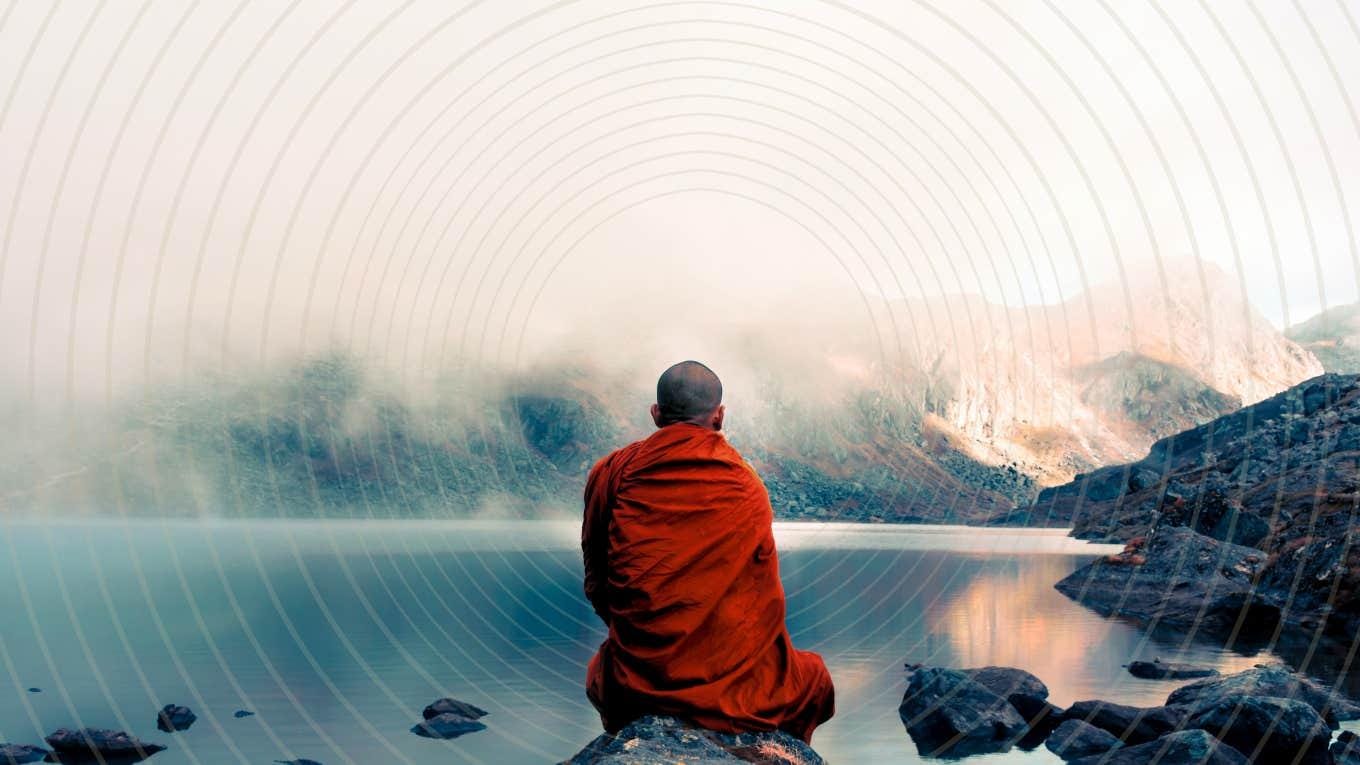
If misery reminds us of our vulnerability, and majesty awakens our wonder, mystery teaches us humility.
Modern civilisation has achieved remarkable explanatory power. We know enormously more about the universe, the human body, evolution and the workings of nature than earlier generations could have imagined.
Yet explanation does not exhaust experience.
We can study the neurological processes associated with love without exhausting the personal significance of loving someone. We can investigate the biological mechanisms of death without resolving every existential question raised by mortality. We can analyse the psychological benefits of meditation without settling the metaphysical questions that different contemplative traditions associate with it.
There is a difference between explaining a phenomenon and exhausting its meaning.
In my earlier work, Ever Approachable, Never Attainable, I explored the relationship between scientific understanding and the horizons that continually exceed our grasp. The human search for truth is remarkable precisely because it combines genuine discovery with the recognition that understanding remains incomplete.
Mystery, understood properly, is not a convenient substitute for ignorance.
When we do not know the cause of a disease, our responsibility is to investigate it. When we encounter injustice, our task is not to declare it mysterious and accept it. When a religious authority makes a questionable claim, intellectual honesty requires us to examine it critically.
Mystery becomes meaningful only when it follows, accompanies or challenges serious inquiry.
It refers to dimensions of existence that invite continued engagement rather than premature closure.
In this sense, spiritual maturity requires the capacity to say three things: I know something. I do not know everything. I remain willing to learn.
This attitude is especially important in interreligious encounters.
The Christian understanding of a personal and relational God is not simply identical with Buddhist accounts of liberation, Advaita Vedānta’s interpretation of ultimate reality, or secular humanistic interpretations of meaningful existence.
To pretend otherwise would be intellectually dishonest.
But difference need not become hostility. Indeed, recognising that others arrive at different conclusions through serious reflection can encourage philosophical humility.
I may remain committed to my convictions while acknowledging that my understanding is incomplete, that my language is historically conditioned and that another person’s experience may reveal something important about the human search for meaning.

A spirituality incapable of intellectual humility eventually becomes ideology.
A spirituality incapable of commitment becomes mere curiosity.
Inclusive spirituality seeks a more demanding position: conviction without arrogance, openness without superficiality, and faith without the fear of questioning.
6. The Three Dimensions of a Fully Human Life
The three dimensions of misery, majesty and mystery do not describe separate stages that we eventually leave behind. They are simultaneous features of human existence.
A person receiving treatment for a serious illness may experience misery through pain, majesty through the loving presence of family, and mystery through questions about life, death and ultimate meaning.
A young person entering university may experience misery through economic hardship, majesty through intellectual discovery, and mystery through uncertainty about personal identity and vocation.
Even a successful professional may encounter misery through loneliness, majesty through creative achievement, and mystery through an unexpected question about the purpose of success.
We do not ordinarily live these dimensions separately. We inhabit them together.
Inclusive spirituality: Embracing the whole of life
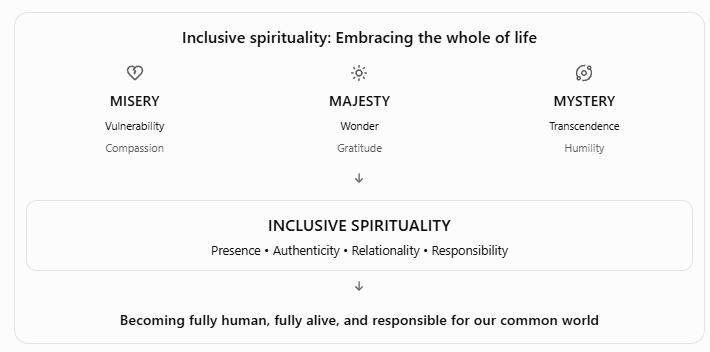
What happens when one dimension is excluded?
A spirituality concerned only with misery risks becoming pessimistic, burdened by suffering and unable to celebrate existence.
A spirituality concerned only with majesty may become sentimental, overlooking injustice and the fragility of human life.
A spirituality concerned only with mystery can become detached from concrete relationships, turning transcendence into an excuse for avoiding responsibility.
The task is not to choose among them, but to learn their interdependence.
Compassion responds to misery. Gratitude receives majesty. Humility acknowledges mystery.
Together they create the possibility of a spirituality that is emotionally mature, intellectually honest and ethically demanding.
7. Decode Your Why: From Achievement to Meaning
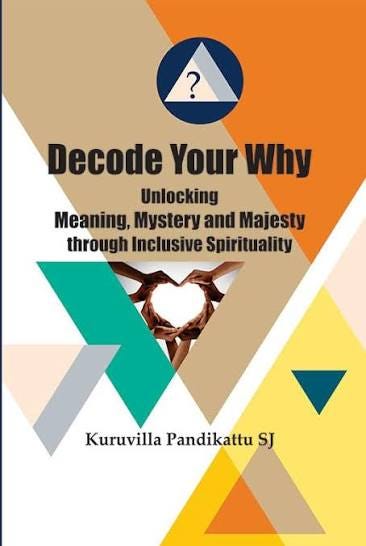
Decode Your Why: Unlocking Meaning, Mystery and Majesty through Inclusive Spirituality
The search for meaning becomes urgent when success alone no longer answers our deepest questions.
It is not enough to ask what we can achieve. We must also ask why the achievement matters, whom it serves and what kind of person we become through pursuing it.
A young student may ask why education matters. A manager may wonder whether professional success can coexist with personal integrity. A person facing bereavement may question the meaning of suffering. Someone approaching retirement may ask what remains when professional identity begins to recede.
These are not identical problems. Nevertheless, they share an underlying concern with meaning.
My book Decode Your Why develops this search through questions of identity, suffering, spiritual traditions, ethical values, rituals, mortality and ordinary living.
The question why? is deceptively simple.
A child asks why the sky is blue. A scientist asks why physical phenomena behave as they do. A philosopher asks why anything exists at all. A person in distress asks why suffering has entered a particular life.
The same word moves from explanation to justification, from curiosity to meaning, from causation to purpose.
It is important not to confuse these different questions.
A scientific explanation may tell us why a biological process occurs. It cannot, by itself, tell us what obligations we have towards someone undergoing that process.
An economic analysis may explain the causes of unemployment. It does not exhaust the ethical question of what society owes those whose livelihoods have disappeared.
A psychological explanation may identify the conditions associated with happiness. It cannot settle every philosophical disagreement about what makes a human life genuinely worthwhile.
Spirituality enters this wider territory of significance, value and commitment.
But we must resist another temptation: the assumption that every person has one fixed purpose waiting to be discovered.
Some people experience meaning through religious vocation, parenthood, scientific inquiry, artistic creation or public service. Others discover new purposes after illness, migration, failure or the loss of an earlier identity.
Meaning is not always found in one dramatic moment. It may gradually emerge through the quality of our relationships, the responsibilities we accept and the ordinary commitments we sustain.
The question therefore changes.
Instead of asking only what I want from life, I begin to ask what life is asking of me.
Instead of treating purpose as a private possession, I begin to understand it as something realised in relationship.
Decoding our WHY: Four questions
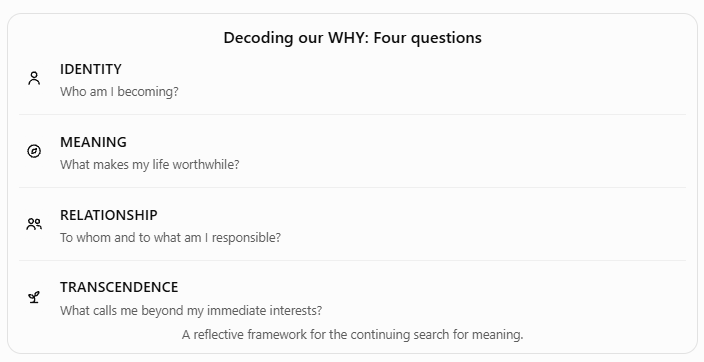
I find this movement particularly significant in a culture increasingly dominated by performance.
We measure ourselves through grades, salaries, publications, recognition, promotions and possessions. These measures may reflect genuine accomplishments. They become problematic when they are mistaken for the whole of human worth.
The question of meaning interrupts the logic of endless comparison.
It reminds us that a successful life and a meaningful life are related, but not identical.
Someone may accomplish much and remain dissatisfied. Another may lead an outwardly ordinary life marked by generosity, integrity and deep relationships.
We need not romanticise poverty, suffering or limited opportunity to acknowledge this distinction. Material security matters. Education and economic independence matter. Professional excellence matters.
The point is that these achievements must be situated within a more adequate understanding of human flourishing.
Inclusive spirituality does not diminish excellence. It gives excellence a humane purpose.
8. Can Different Religions Enrich One Another?
9
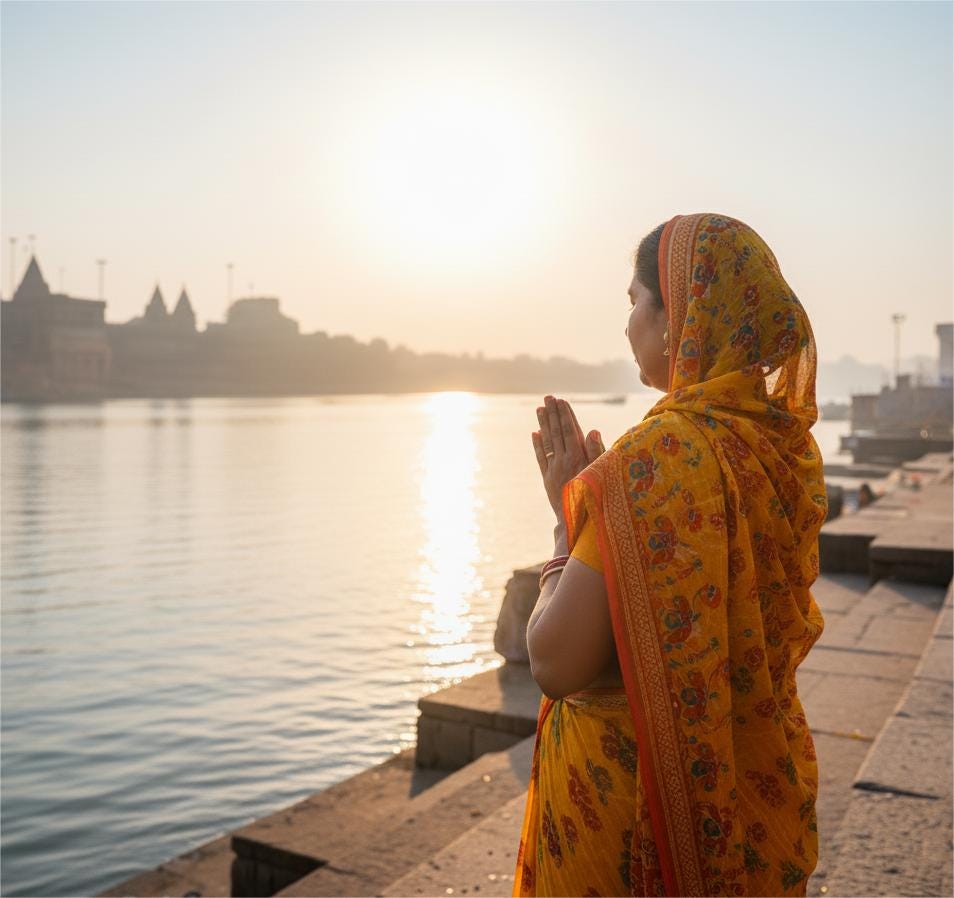
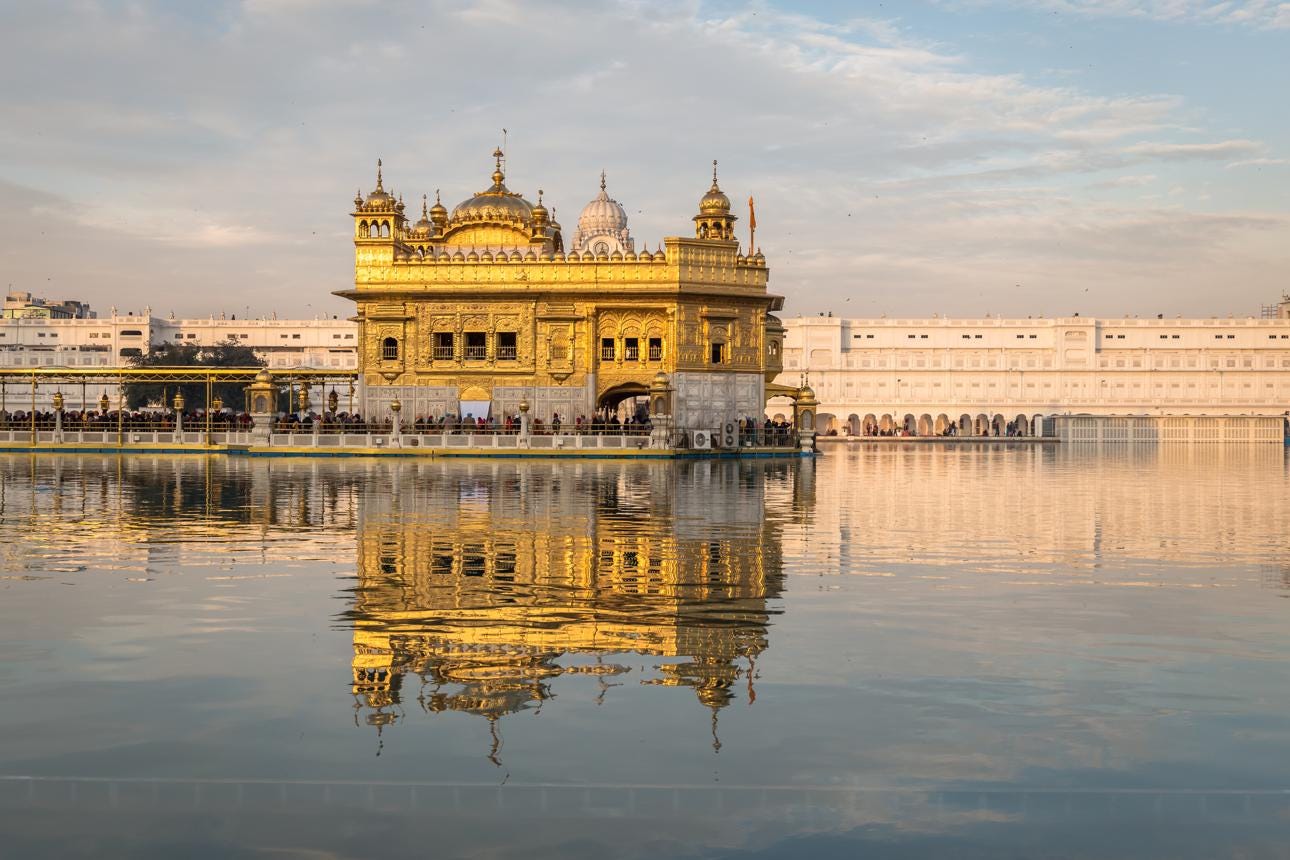
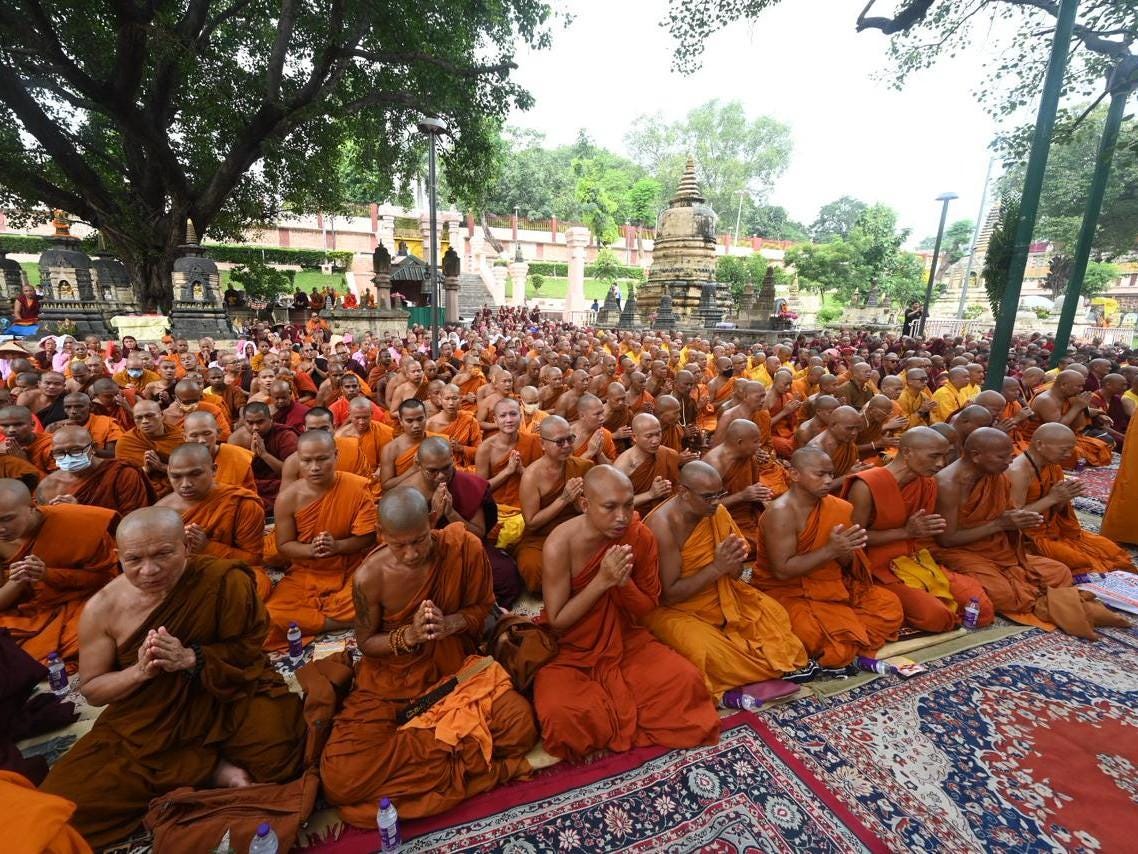
Religious plurality is one of the defining realities of Indian civilisation. Hinduism, Buddhism, Jainism, Sikhism, Islam, Christianity, indigenous spiritual traditions and numerous other expressions of faith have shaped our intellectual, cultural and ethical inheritance.
Their relationships have not always been peaceful. Historical coexistence must not be idealised. There have been periods of exchange and cooperation, but also exclusion, competition, appropriation and violence.
Nevertheless, plurality provides an opportunity for deeper reflection.
The Upanishadic traditions encourage inquiry into the relationship between the self and ultimate reality. Buddhist traditions offer sophisticated reflections on impermanence, attachment, compassion and liberation. Jain philosophy develops a demanding ethic of nonviolence and a recognition of the limitations of partial viewpoints. Sikh tradition joins devotion with equality, service and the dignity of work.
Islamic spiritual traditions emphasise divine unity, surrender, justice and remembrance. Sufi traditions cultivate disciplines of love, devotion and interior transformation. Christianity understands love, reconciliation, grace and the dignity of the person through its particular theological convictions and through the life of Jesus.
Indigenous and tribal spiritual traditions frequently express relationships among community, ancestry, land and ecological belonging, although they must not be reduced to a single worldview.
Secular humanists, too, may cultivate serious commitments to reason, freedom, compassion and human dignity without grounding them in belief in a deity.
These traditions cannot simply be added together as though they were interchangeable ingredients.
A meaningful encounter requires patience with difference.
For example, the Buddhist understanding of anattā, or not-self, cannot straightforwardly be equated with the Christian theological understanding of personhood. Theistic and non-theistic approaches to ultimate reality differ in fundamental ways.
Yet these disagreements need not prevent mutual learning.
The question is whether we can allow encounters to deepen moral understanding without erasing intellectual disagreement.
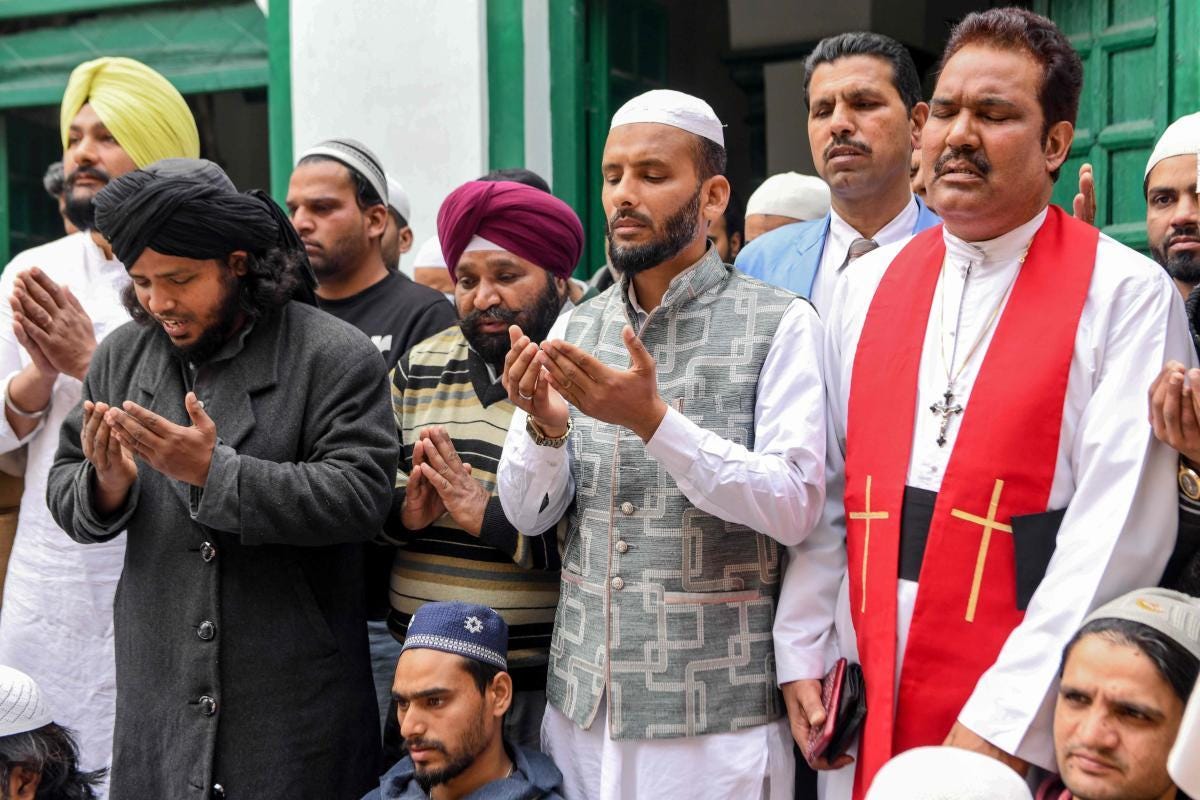
An experience of solidarity beyond religious boundaries
During the communal violence that affected northeast Delhi in February 2020, there were accounts of neighbours from different religious communities protecting one another and defending shared localities against mobs.
Such actions deserve attention because they reveal a form of solidarity stronger than sectarian categorisation.
The people involved did not necessarily abandon their religious differences. Rather, they recognised that the protection of their neighbours’ lives mattered more immediately than inherited divisions.
In such situations, inclusive spirituality moves beyond religious meetings, conferences and declarations.
It becomes the courage to protect another person when doing so entails risk.
Interreligious dialogue is important. But solidarity in times of vulnerability may reveal more about the moral seriousness of faith than declarations of harmony delivered in comfortable circumstances.
We should therefore ask not merely whether people of different religions can pray together, but whether they can live together justly, protect one another and cooperate for the common good.
That is a far more demanding test.
9. The Danger of Spiritual Consumerism: When Even the Sacred Becomes a Commodity
Contemporary society has developed a remarkable ability to convert almost every human aspiration into a marketable product.
We purchase experiences of tranquillity, subscribe to meditation applications, attend expensive retreats, consume motivational literature and seek techniques for greater happiness, productivity and self-fulfilment.
None of these activities is necessarily objectionable. A meditation application may help someone develop attention. A retreat may offer valuable opportunities for reflection. Professional counselling, physical exercise and contemplative practices can contribute to personal well-being.
The ethical problem arises when spirituality itself becomes another instrument of consumption.
We begin to purchase experiences rather than cultivate commitments. We seek tranquillity without transformation, inner peace without justice, and personal enlightenment without responsibility for others.
Spirituality then risks becoming an extension of the very consumerist mentality from which it claims to liberate us.
A company may offer employees mindfulness sessions while maintaining unreasonable working conditions. A wealthy individual may attend expensive spiritual retreats while remaining indifferent to those whose labour makes such privileges possible.
A person may practise compassion during meditation and behave harshly towards subordinates at work.
These are not arguments against contemplative practice. They are arguments against separating contemplation from ethical responsibility.
A spirituality that enables us to tolerate injustice more comfortably, without questioning injustice itself, has become morally compromised.
The central issue is transformation.
Does spiritual practice make us more truthful? More compassionate? More attentive to vulnerability? More willing to accept criticism? More responsible in our use of power?
If it does not, we must ask what exactly has been transformed.
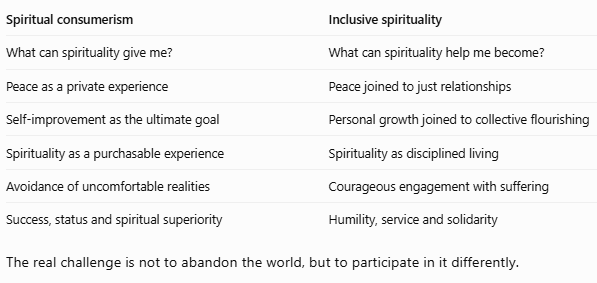
We need a spirituality that can enter our homes, workplaces, educational institutions and public life without becoming captive to the pursuit of status, power or profit.
10. From Personal Spirituality to Collective Flourishing
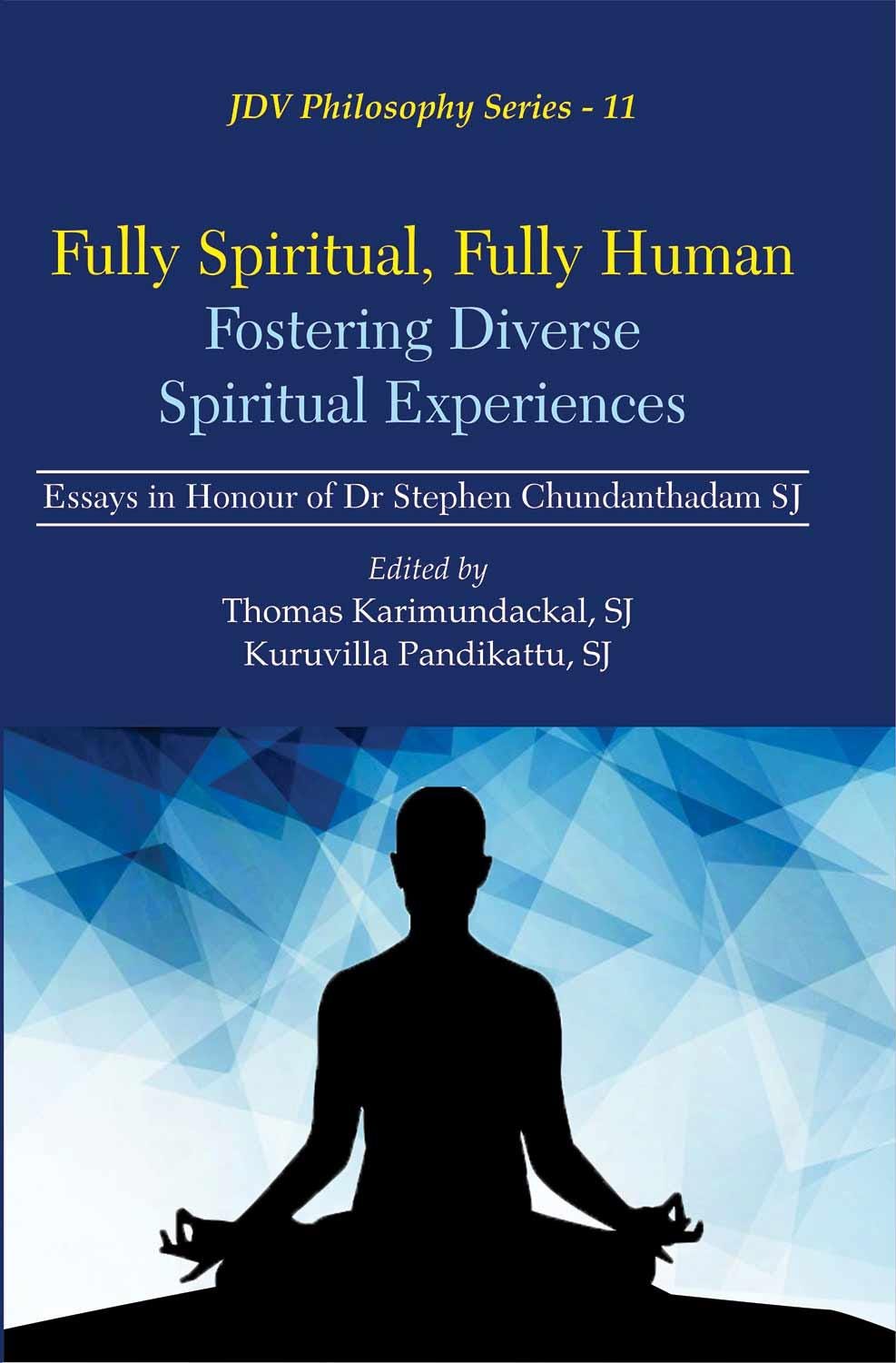
Inclusive Spirituality and Ethical Leadership
Reimagining Business and Society for Our Collective Flourishing
My 2025 edited volume extends the discussion into organisational and public life.
It asks whether spirituality can contribute to institutions that cultivate dignity, ethical responsibility, ecological sensitivity and concern for the common good.
Human flourishing is not merely an individual achievement.
A person may cultivate considerable inner tranquillity and still inhabit an unjust society. An organisation may have spiritually reflective leaders while maintaining damaging institutional practices.
If spirituality is genuinely relational, it must eventually affect our collective arrangements.
In management education, I have repeatedly encountered an important question: Can spirituality contribute meaningfully to leadership without becoming another fashionable managerial technique?
I believe it can, but only if we resist reducing it to improved employee performance or organisational profitability.
Spirituality should not merely help managers become calmer while exercising power. It should encourage them to examine the legitimacy, purpose and consequences of that power.
A spiritually responsible organisation must ask whether its practices respect human dignity, whether its economic gains impose unacceptable costs upon others, and whether its long-term strategy contributes to the flourishing of communities and the environment.
This is one reason I have explored the relationship between inclusive spirituality, the EthicoSphere and corporate spiritual responsibility.
Conventional corporate social responsibility has often focused on programmes, charitable initiatives and public commitments. These can be valuable, but they do not necessarily transform an organisation’s motives or daily operations.
A deeper conception of responsibility asks whether ethical concern has become integral to organisational culture.
It asks whether compassion influences recruitment, whether integrity governs financial decisions, whether ecological responsibility shapes production, and whether leadership creates conditions in which people are respected rather than merely utilised.
Such responsibility cannot be achieved through spiritual language alone.
It requires governance, accountability, fair practices and the willingness to change arrangements that benefit some while harming others.
Spirituality becomes socially meaningful when it contributes to such change.
11. How Do We Cultivate Inclusive Spirituality?

We must finally move from reflection to practice.
Inclusive spirituality is not a doctrine that can be mastered once and permanently possessed. It is a way of living that must be renewed through attention, discernment and responsibility.
I propose seven interrelated disciplines.
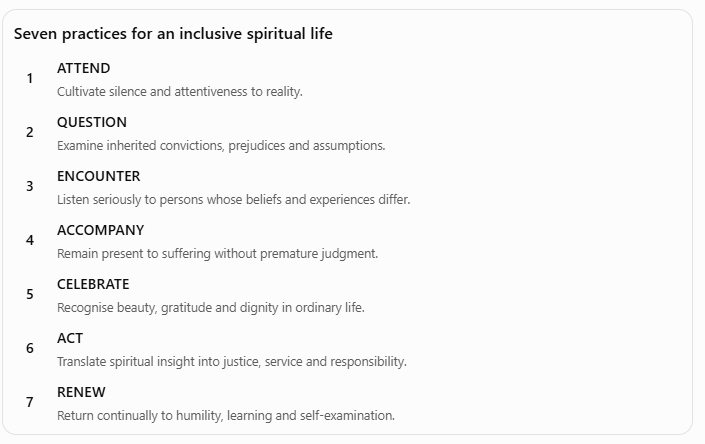
The first discipline is attention. We must recover the capacity to be present. Silence need not mean withdrawing from the world. It can mean becoming sufficiently attentive to hear what our constant activity usually conceals.
The second is questioning. Spiritual maturity requires intellectual courage. We must be willing to examine inherited prejudices, convenient certainties and interpretations of religion that legitimise exclusion or humiliation.
The third is encounter. We must create opportunities to know people beyond our familiar social circles. Genuine encounter means allowing another person to challenge our assumptions rather than simply confirming them.
The fourth is accompaniment. Instead of explaining away suffering, we must learn to respond to it. Compassion becomes credible through concrete commitments of time, resources and presence.
The fifth is celebration. We must cultivate gratitude for existence without turning gratitude into denial. Wonder at the beauty of life should coexist with awareness of its vulnerability.
The sixth is action. Ethical concern must influence our choices as consumers, citizens, professionals, religious believers and members of institutions. A spirituality that never affects behaviour remains incomplete.
The seventh is renewal. None of us becomes permanently enlightened, compassionate or morally consistent. We remain vulnerable to selfishness, fear, vanity and prejudice. Spiritual growth therefore requires continuing reflection, correction and sometimes the courage to begin again.
These practices do not promise a life without conflict or suffering. They invite us to inhabit our difficulties with greater honesty, courage and openness.
12. The Future of Spirituality: Towards a Shared Human Destiny
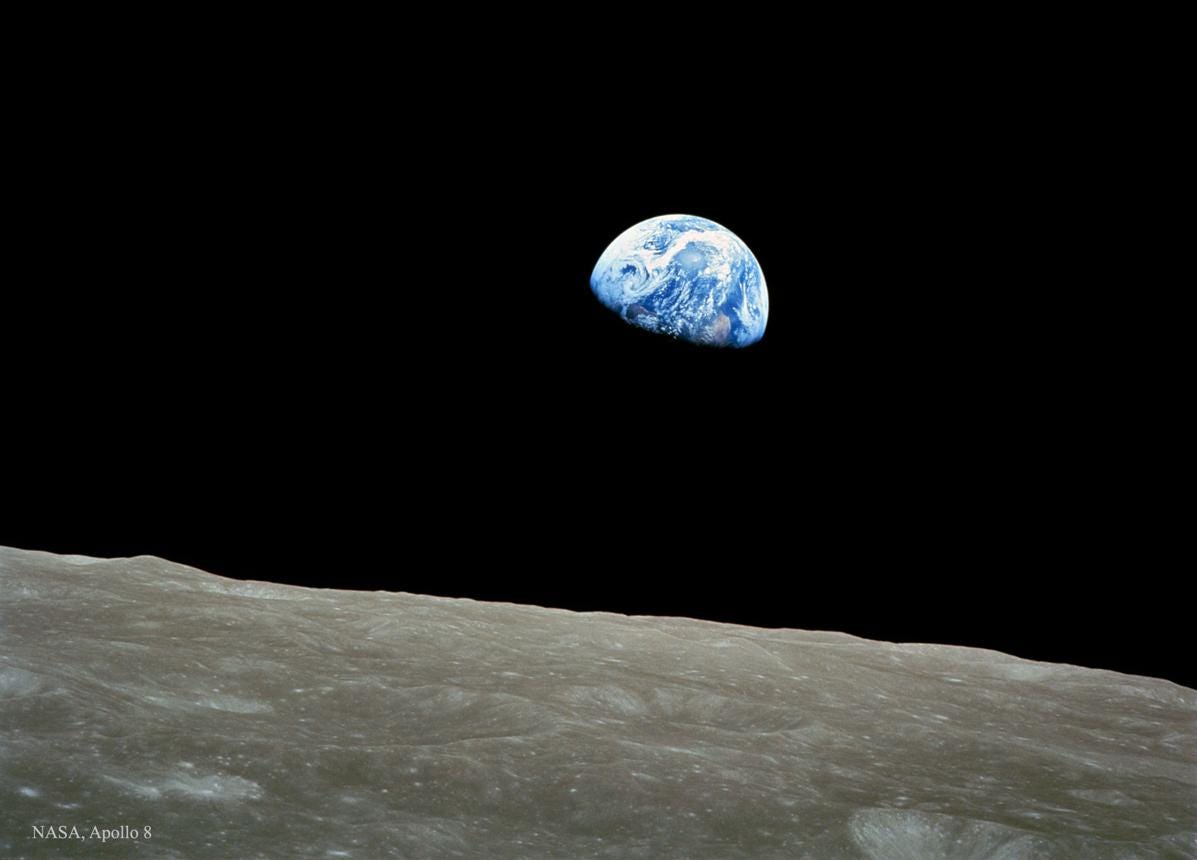
When the first photographs of Earth from space reached humanity, they offered a striking new perspective on our common home.
From that distance, the boundaries that divide nations became invisible. The planet appeared as a fragile and beautiful whole, suspended within an immense cosmos.
Such images do not dissolve religious disagreements or political conflicts. But they challenge us to reconsider the scale of our belonging.
Our ecological future is shared. Our technological choices increasingly affect distant populations. Pandemics, environmental degradation and the risks associated with advanced technologies reveal how deeply our lives are interconnected.
In this context, inclusive spirituality becomes more than a personal preference. It offers a way of thinking about our responsibilities as participants in a shared human destiny.
A spirituality confined exclusively to individual salvation or personal tranquillity will struggle to respond adequately to these challenges.
We need spiritual traditions capable of bringing their deepest ethical resources into conversation with one another and with the insights of science, philosophy and secular humanism.
Such dialogue must remain intellectually serious. It cannot rest on the simplistic claim that all religions say the same thing. Nor should it require the abandonment of deep convictions.
It must instead cultivate a form of solidarity that can survive disagreement.
One may understand the sacred through a personal God, an ultimate reality beyond conceptual distinctions, the interconnectedness of life or a secular commitment to human dignity.
These positions are not interchangeable.
Yet their adherents can cooperate in protecting vulnerable people, resisting violence, caring for the environment and building institutions that enable human flourishing.
Our greatest shared responsibility may be to ensure that philosophical and religious differences do not prevent us from addressing suffering that we can alleviate together.
The spirituality of belonging
I want to suggest one final distinction.
Much of modern life encourages us to think of existence in terms of possession. We possess knowledge, wealth, qualifications, identities, convictions and relationships.
Even spirituality can become something we imagine ourselves possessing.
But belonging operates differently.
We belong to families, communities, histories, traditions and ecological systems. We are shaped by relationships we did not create and sustained by forms of dependence we cannot entirely overcome.
Before we become independent agents, we are vulnerable beings who receive life, care, language and social recognition from others.
To acknowledge this is not to deny freedom. It is to understand that freedom itself develops within relationships.
Our deepest fulfilment may therefore lie not in becoming entirely self-sufficient, but in learning to participate responsibly in a world that has already given us so much.
This is why inclusive spirituality must ultimately become a spirituality of belonging.
It invites us to move beyond the isolated self without extinguishing personal identity, beyond religious exclusivism without abandoning conviction, and beyond spiritual comfort without rejecting the legitimate need for inner peace.
13. Becoming Fully Human: The Invitation Before Us

We began by observing the strange paradox of contemporary civilisation.
We are technologically connected but often emotionally divided. We possess extraordinary knowledge but remain uncertain about our collective responsibilities. We affirm the dignity of human life while tolerating arrangements that compromise it.
Inclusive spirituality does not provide an easy solution to these contradictions.
It does something more demanding.
It asks us to change the way we live.
To embrace misery means refusing to abandon people in their vulnerability. To celebrate majesty means recognising the dignity, beauty and extraordinary possibilities present within ordinary existence. To live with mystery means accepting the limits of our understanding without surrendering our search for truth.
These are not merely three spiritual experiences. Together they offer a way of becoming more fully human.
The task is lifelong.
We must learn to listen without immediately judging, to believe without becoming arrogant, to question without becoming cynical, and to serve without seeking superiority.
We must cultivate the courage to remain rooted while remaining open. We must acknowledge the distinctiveness of our traditions while accepting responsibilities that extend beyond their boundaries.
We must also recognise that spirituality is not validated simply by the intensity of our private experiences.
Its authenticity becomes visible in the quality of our relationships, the integrity of our choices, the compassion we extend towards vulnerability, and the justice we help establish through our institutions.
When the spirituality we practise makes us more hostile, more self-righteous or more indifferent to suffering, we need to question what it has become.
When it makes us more attentive, truthful, courageous, compassionate and responsible, we have reason to believe that something important is taking place.
I have spent much of my intellectual life reflecting on the human person through science, philosophy, theology and ethics. These disciplines have not eliminated the mysteries of existence. They have made me more attentive to its richness, fragility and extraordinary possibilities.
I have also become increasingly convinced that our future cannot be secured through technological advancement alone.
We need wisdom that can guide knowledge, compassion that can humanise institutions, and a sense of belonging that can overcome the divisions we so readily create.
The question before us is not merely whether we can become more successful, more intelligent or more powerful.
It is whether we can become more humane.
Whether we can learn to see the stranger not simply as another, but as a person whose dignity makes a claim upon us.
Whether we can discover beauty without becoming indifferent to suffering.
Whether we can acknowledge mystery without abandoning reason.
Whether we can remain faithful to our convictions without surrendering openness.
And whether we can build a civilisation in which human beings and the larger community of life are treated with the reverence they deserve.
Beyond Belief, Towards Belonging
Embrace misery with compassion.
Celebrate majesty with gratitude.
Encounter mystery with humility.
Become fully human. Become fully alive. Help others flourish.
Perhaps the ultimate purpose of spirituality is not to make us feel different from others, but to help us recognise how deeply we belong to one another.
And perhaps our most meaningful achievement will not be discovering a spirituality that separates us from the world, but cultivating one that enables us to love, serve and transform the world more fully.
For the measure of a spiritual life is not how far we have travelled away from others, but how deeply we have learned to belong with them.